The PM2.5 will be the cerium oxide glass polishing powder which average particle size is 2.5 micron.[3] All two facemasks should have the ability to separate the PM2.5 fine particulates. And as the control group, there will be a facemask which can not obstruct the PM2.5.
The facemasks list is:
KOWA PM2.5 Face Mask
3M 1826 Earloop Fluid Resistant Face Mask (Control Group)
The masks with N95 means then when subjected to careful testing, the respirator blocks at least 95% of very small (0.3 micron) test particles.[4] So they are able to obstruct the PM2.5 at least 95%.
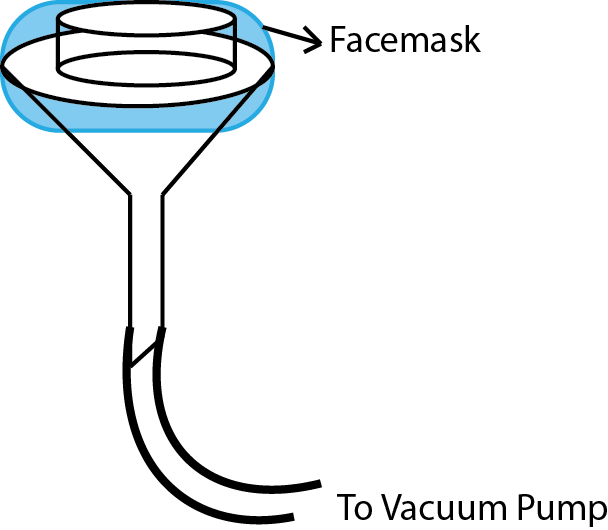
During the test, a funnel was covered by the facemask and attached to the vacuum line. The diameter of the funnel is 50mm and it is made of the glass. After starting the vacuum pump, a small cell culture dish with 35mm which contained 100mg, 300mg and 500mg PM2.5 powder was placed on the facemask. Figure showed how the experiment worked. Turned off the vacuum pump after 5 mins and cut the facemask to about 5mm square. Then coated the facemask with gold thin film by using the Sputtering.
Both sides of the mask and the cross section were tested under SE2 mode, BSE mode and X-ray microanalysis in SEM. Also, the image of SE2 and BSE was colored according to their composition.By using EDX, the ability of particulates’ obstruction in each facemask can be acquired. If the mask has high quality on blocking the PM2.5, the PM2.5 should not exist on the back side of the mask which connect to the vacuum line. The EDX could show the percentage of the cerium oxide on the surface and compare to each other.