Introduction

Almost every quantum science experiment requires ultra-low temperatures, typically well under 1K. Semiconductor spin qubits are no exception, and they are limited by the temperature of electrons in the 2D electron gas (2DEG) plateauing around 150mK despite cryogenic dilution fridges allowing the rest of the material to reach temperatures as low as 5mK. Edwards (1993) proposed the development of a quantum dot refrigerator (QDR) to reduce electron temperatures within some isolated region [1]. While Prance (2009) developed the first QDR in GaAs, it hasn't been applied to SiGe heterostructures yet [2]. A challenging aspect of developing a SiGe QDR is to accurately measure the electron temperature without introducing unwanted heat to the reservoir. This semester, we have designed and built two devices: a quantum dot refrigerator and a temperature probe with a heating channel. In this report, we will briefly discuss the working principles and fabrication of the two prototype devices, and then share the results of applying scanning electron microscopy (SEM) and atomic force microscopy (AFM) to analyze the prototypes.

Device Design and Fabrication

Since thermoelectricity is a new research direction for the Nichol group, we have been designing a series of new devices. For the OPT407 project, three of these new designs were fabricated. However, one of the three has since been ruled out as a necessary platform for future experiments and has been excluded from this report. Below, is a brief explanation of the two primary devices and their working principles. Note that since the focus of this project is on metrological techniques, this will be only be a limited explanation of the physics. 

Quantum Dot Refrigerator

The simplest explanation of the quantum dot refrigerator is that it creates an island of electrons for which only hot electrons can leave and cold electrons can enter. This means that as a current passes through the island, the average temperature of the island is lowered. To be a bit more technical,  energy-selective tunneling through quantum dots on either side of the island is used to control the electron flow. An energy diagram illustrating this is shown in figure 1.

Temperature Probe with Heating Channel
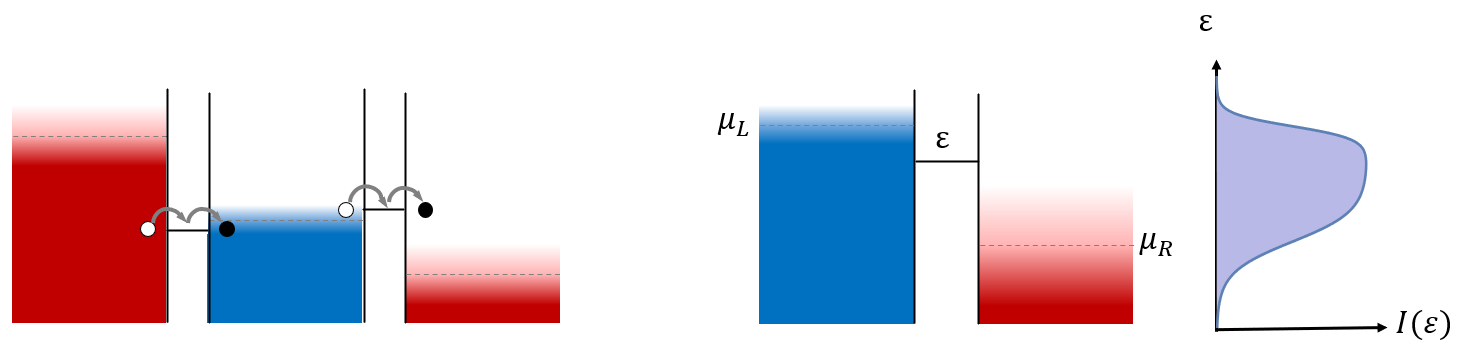
To measure the temperature of a quantum ensemble of electrons, one must determine the energy distribution of the particles and fit it to the Fermi-Dirac distribution. For electrons in a 2DEG there are two established ways of measuring the distribution. The first is to measure the current while sweeping the dot's energy level through the Coulomb-blockaded regions as shown in the figure below [3]. The second is to have a dot singularly connected to the reservoir of interest and use a charge-sensing dot to measure the probability of the dot being occupied at different energy levels [4]. The device we designed will be able to utilize both methods, while also using a heating channel to modify temperatures on one side of the dot. 

Figure 1
Basic energy-level diagrams to illustrate the working principles of the QDR ( left ) and temperature probe (right ).  In these diagrams, energy is represented with the vertical axis and the fullness of the colors is proportional to the probability that a state at a given energy level is filled. Following the electron path from left to right in the QDR design we see: an electron may tunnel from the left lead to one of the lowest energy states in the island while another electron from one of the hottest island energy states can tunnel through the right dot to other lead. In the temperature probe diagram, we show the current through the dot as a function of the dot's energy level, ​ε. The current is Coulomb blockaded when ​ε is too high (low) and for any electrons to enter (leave) the dot. The shape of the current vs ε graph at the boundary of the Coulomb blockaded regions is proportional to the temperature.
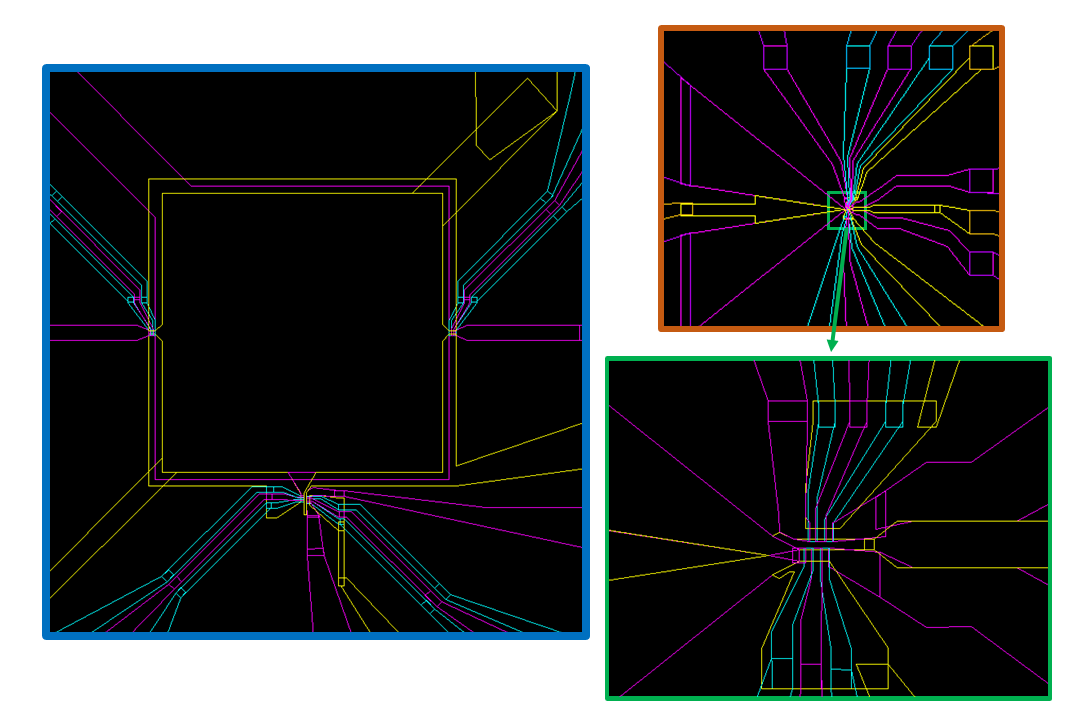
Figure 2
Left: AutoCAD model for the QDR device.  Right: AutoCAD models for the temperature probe device at low (above) and high (below) magnifications. The colors represent the different gate layers: screening gates are yellow, tunneling gates are cyan, and the accumulation/plunger gates are magenta.

Fabrication

These prototype devices were fabricated on a single chip of undoped Si with three overlapping layers of electron beam lithography (EBL) defined gates. Each layer was created by exposing single layer PMMA resist with 1300 μm/cm^2 with a 100pA beam at 50 kV accelerating voltage. Following exposure, the resist was developed in MIBK:IPA 1:3 and had an aluminum film sputter coated on top. The thickness of the Al screening, tunneling, and accumulation/plunger gates are 30, 50, and 70 nm respectively.
Device Analysis

We have implemented several imaging techniques to better understand the quality (or lack thereof)  of our devices. The methods used are optical microscopy, scanning electron microscopy (with the in-lens and secondary electron detectors), and atomic force microscopy.

Optical Microscopy

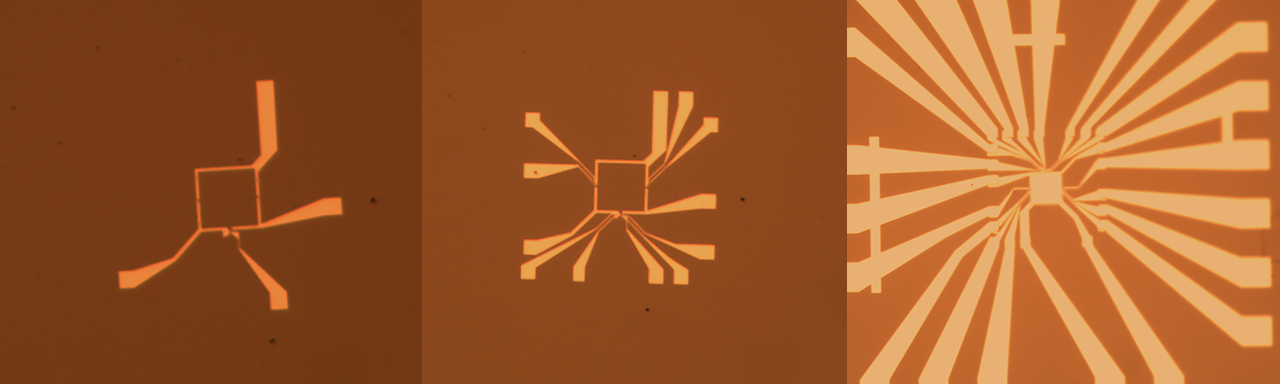
A light microscope was used frequently during the fabrication of these devices. The uses include: checking the uniformity of PMMA resist before exposure, confirming the quality of development after exposure, and viewing the gates after each deposition. In the figure below, we show images of the QDR device after depositing each of the three Al gate layers.

Figure 3
Optical images taken of the QDR device after each layer. In the third layer, we also added all of the large-scale features. This would typically be done with an additional step in each layer rather than all at once. For scale, note that the square reservoir is 10 microns across.

Electron Microscopy

The most important device in our toolbox for diagnosing problems in our fabrication process is the scanning electron microscope (SEM) - and I'm not just saying that because this is the SEM Practicum course!  For this particular device, we utilized two SEM detection modes: secondary electron detection and the in-lens detector. Both of which were valuable in their own ways as you will soon see. 

In lens detector

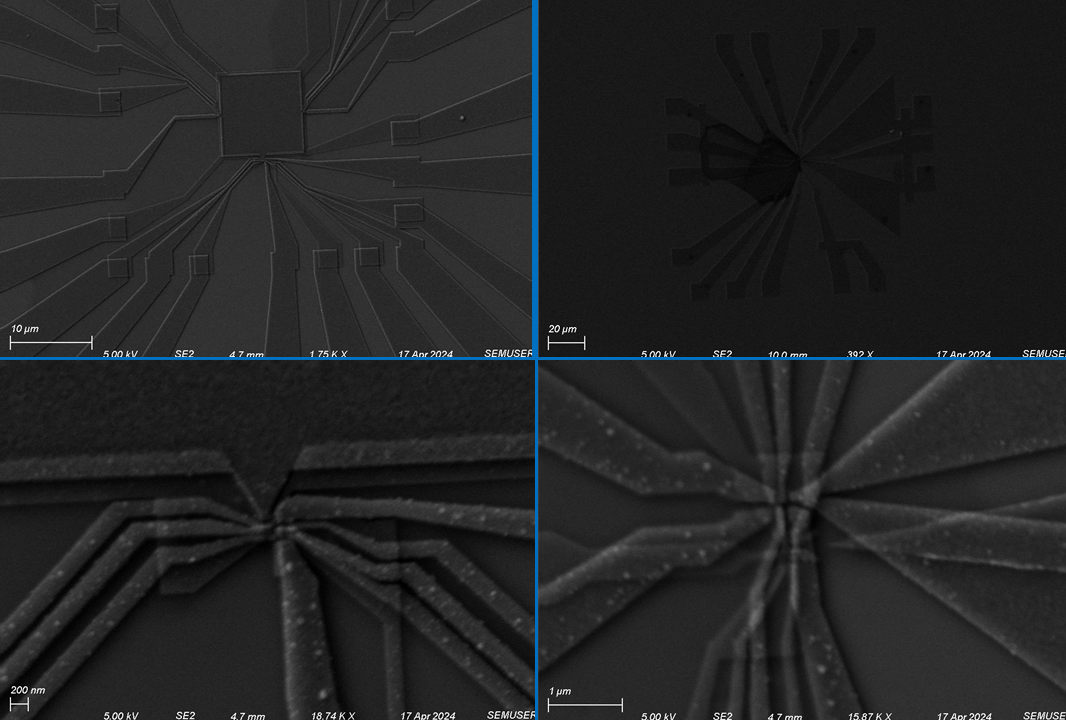
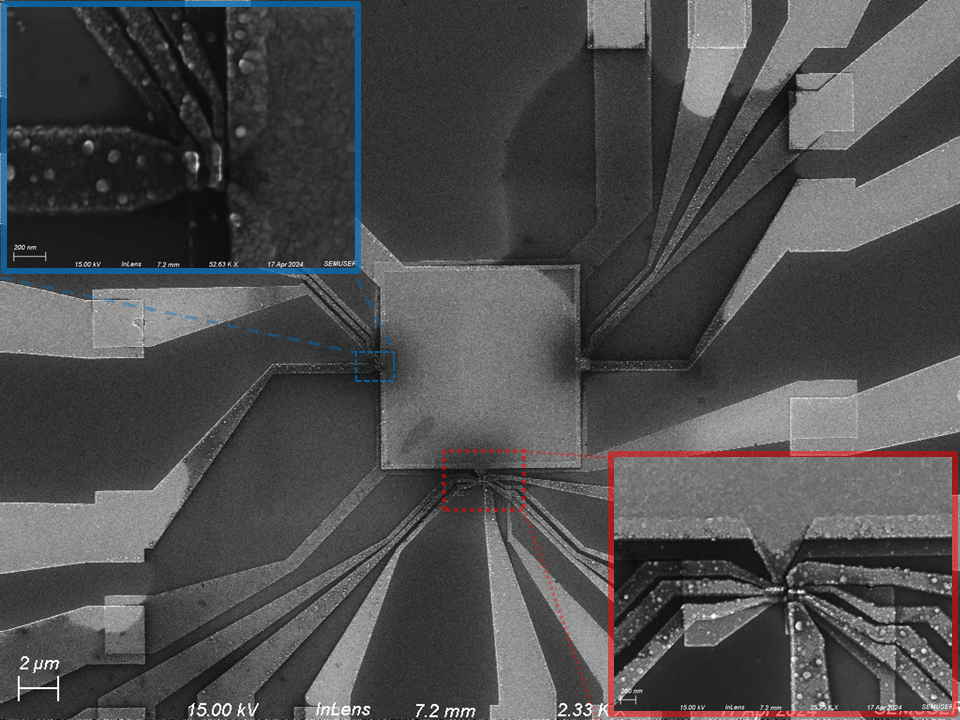
Using the in-lens detector mode of the SEM, we produced good-quality images of the surface of our devices. Unfortunately, the surface of our devices was not good quality. The surface defects may be seen in the scans of the QDR at 15kV accelerating voltage and 7mm working distance below. The problems revealed by this method are as follows.

Figure 4
Results of using the in lens detector at 15kV accelerating voltage to view the QDR device. Inserts show magnified views of two key regions: one of the quantum dot channels, and the temperature probe coupled to the reservoir.

Secondary electron detector

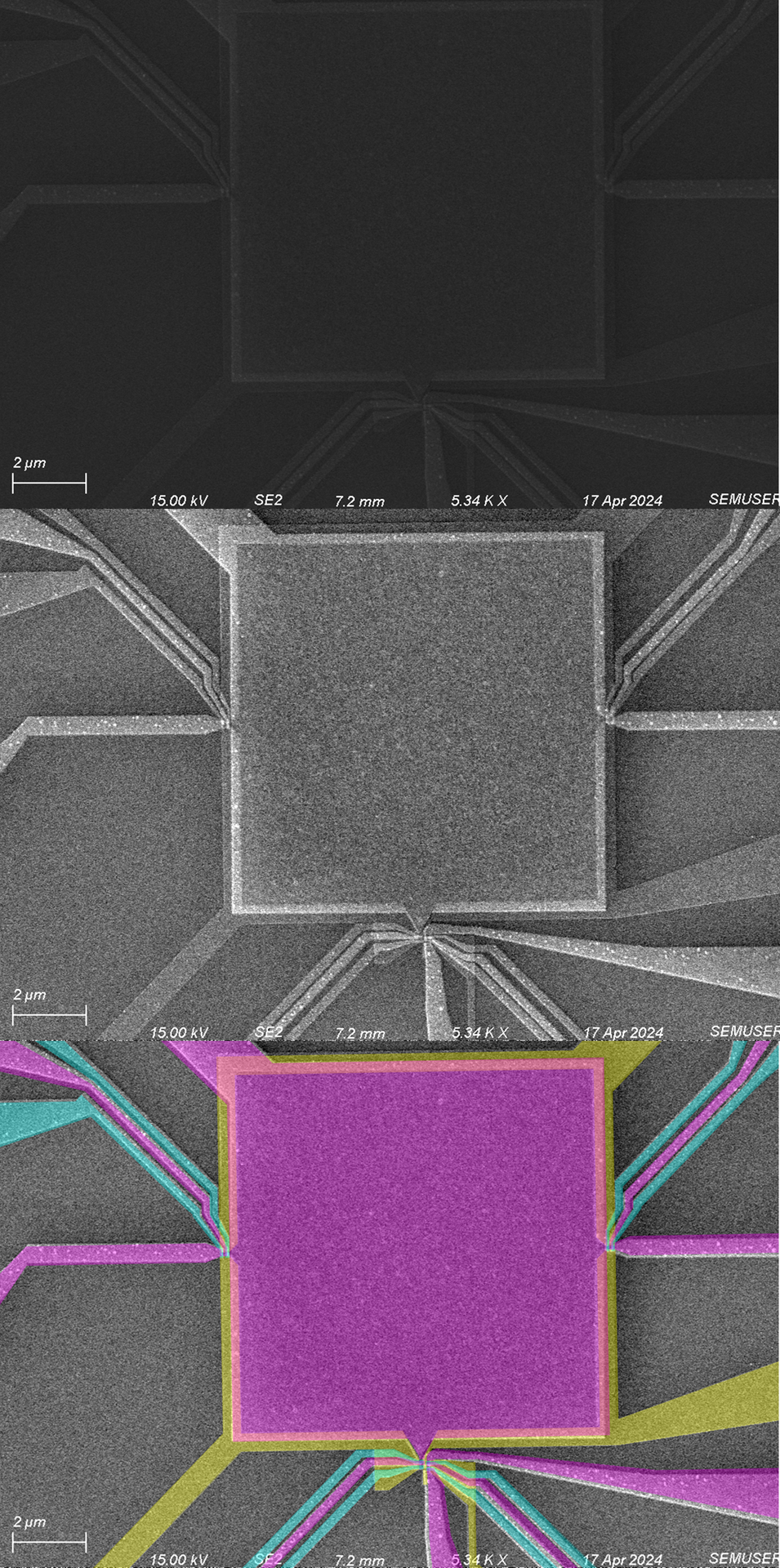
Using the secondary electron (SE) detector, we may mostly look past the discoloring which limits in-lens image analysis. However, these images suffer from poor contrast due to aluminum and silicon having very similar Z values. Being able to look beyond the surface contaminants allows us to analyze the quality of the gate alignment. Below we see a slight misalignment between the small and large features in the QDR and a major misalignment between the accumulation/plunger gates and everything else in the temperature probe. The temperature probe misalignment is due to a failure to find the device's local alignment mark while performing the final exposure.

Figure 5
Results of using the SE detector for the QDR (left) and temperature probe (right).

Image Alteration

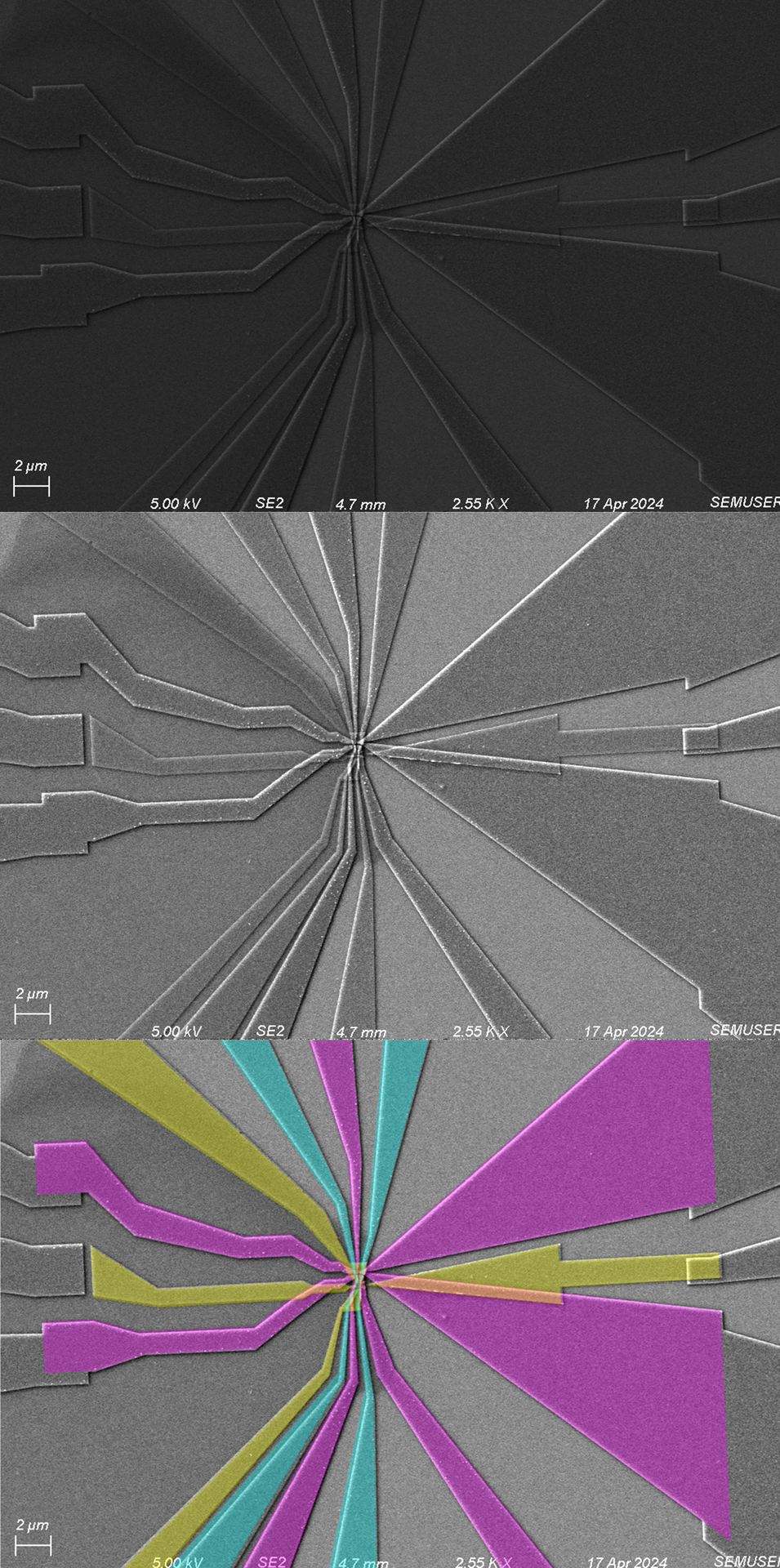
It is often worthwhile to utilize post-image processing to enhance an image for clarity and aesthetics.  To create an illustrative image of a device as it was intended to look, we start with SE scans, which do not show significant surface defects. We then artificially enhance the brightness and contrast of those images using ImageJ. Finally, we apply false coloring by overlaying the gate designs to highlight the different layers on each device.

Figure 6
Top: raw images taken using the secondary electron detector. The left device is the QDR and the right
device is the temperature probe with a heating channel. Middle: The images after artificially enhancing the
contrast and brightness using ImageJ. Bottom: Falsely colored layers were added to distinguish the three gate layers. The layers are: screening gates (yellow), tunneling gates (cyan), and the accumulation/plunger gates (magenta).

Atomic Force Microscopy

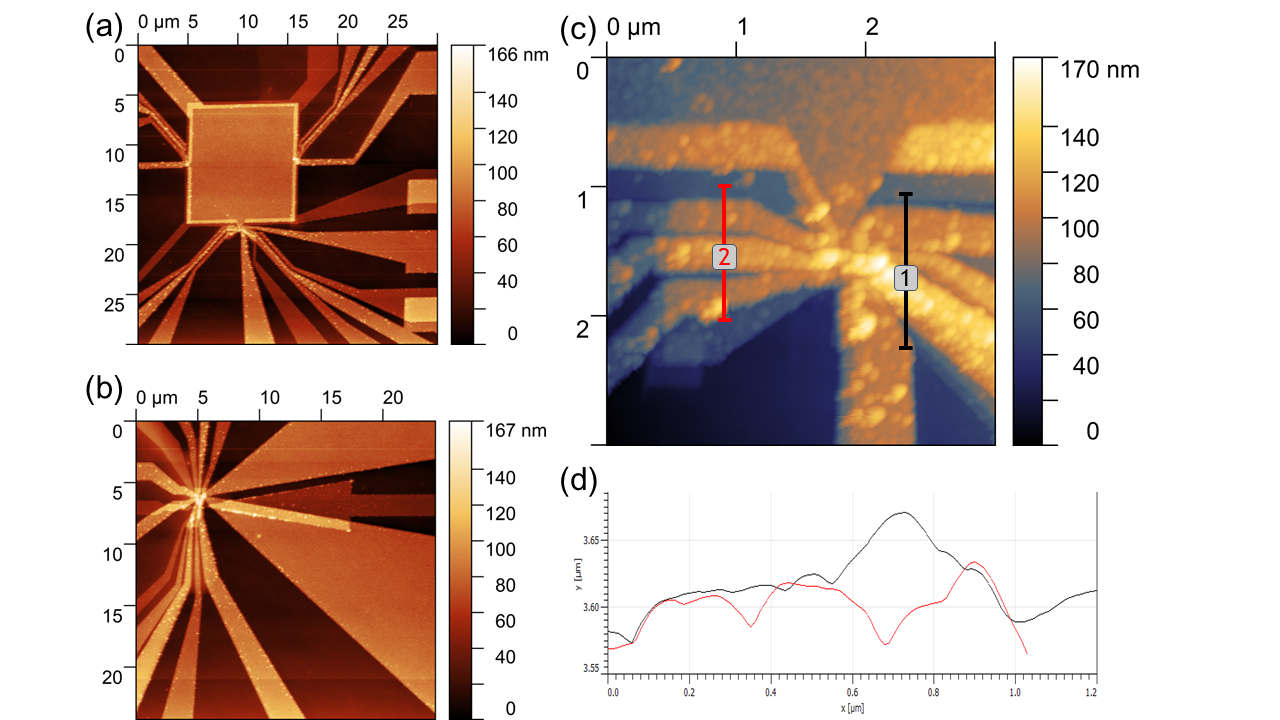
Another useful method to analyze the quality of the gates is atomic force microscopy (AFM). Using AFM, a 3D height map of a region can be made. Below are semi-contact mode scans of the QDR and temp probe with the heating channel. In the QDR device, we also took a close scan over the thermometer dots to analyze the quality of the gate alignment. By looking at linecuts of the height across the two dots, we find the left dot to have acceptable spacing, but the right dot shows substantial overlap.

Figure 7
Wide AFM scans of QDR (a) and temperature probe (b) devices. In the close-scan of the temperature
dots (c), we take a cross section of the height across each dot and plot the results in (d)

Conclusion

The SEM and AFM analyses above have highlighted crucial areas for improvement in device fabrication. The SEM images, particularly those taken with the in-lens detector, indicate greater care must be taken while drying the chips after liftoff. Secondary electron scans indicated that the applied dosage should be reconsidered. The AFM scans have revealed alignment issues which would result in a faulty device. We will adjust our fabrication process to (hopefully) avoid these problems and fabricate working devices in the near future.

Acknowledgements

I would like to thank Sean O’Neil, Greg Madejski, and Ethan Luta for the fantastic instruction I received from them throughout the semester. Additionally, I would like to thank all the members of the Nichol group for their support during this project, particularly Feiyang Ye, and Jiheng Duan for their help in fabrication and Professor John Nichol for his assistance in designing the devices.

References

[1] ​Edwards, H. L., Q. D. Niu, and A. L. De Lozanne. "A quantum‐dot refrigerator." Applied physics letters 63.13 (1993): 1815-1817.
[2] Prance, J. R., et al. "Electronic refrigeration of a two-dimensional electron gas." Physical review letters 102.14 (2009): 146602.
[3] Appleyard, N. J., et al. "Thermometer for the 2D electron gas using 1D thermopower." Physical review letters 81.16 (1998): 3491.
[4] Mavalankar, A., et al. "A non-invasive electron thermometer based on charge sensing of a quantum dot." Applied Physics Letters 103.13 (2013).