
URochester to honor inaugural class of innovators added to Synth Visionaries Gallery
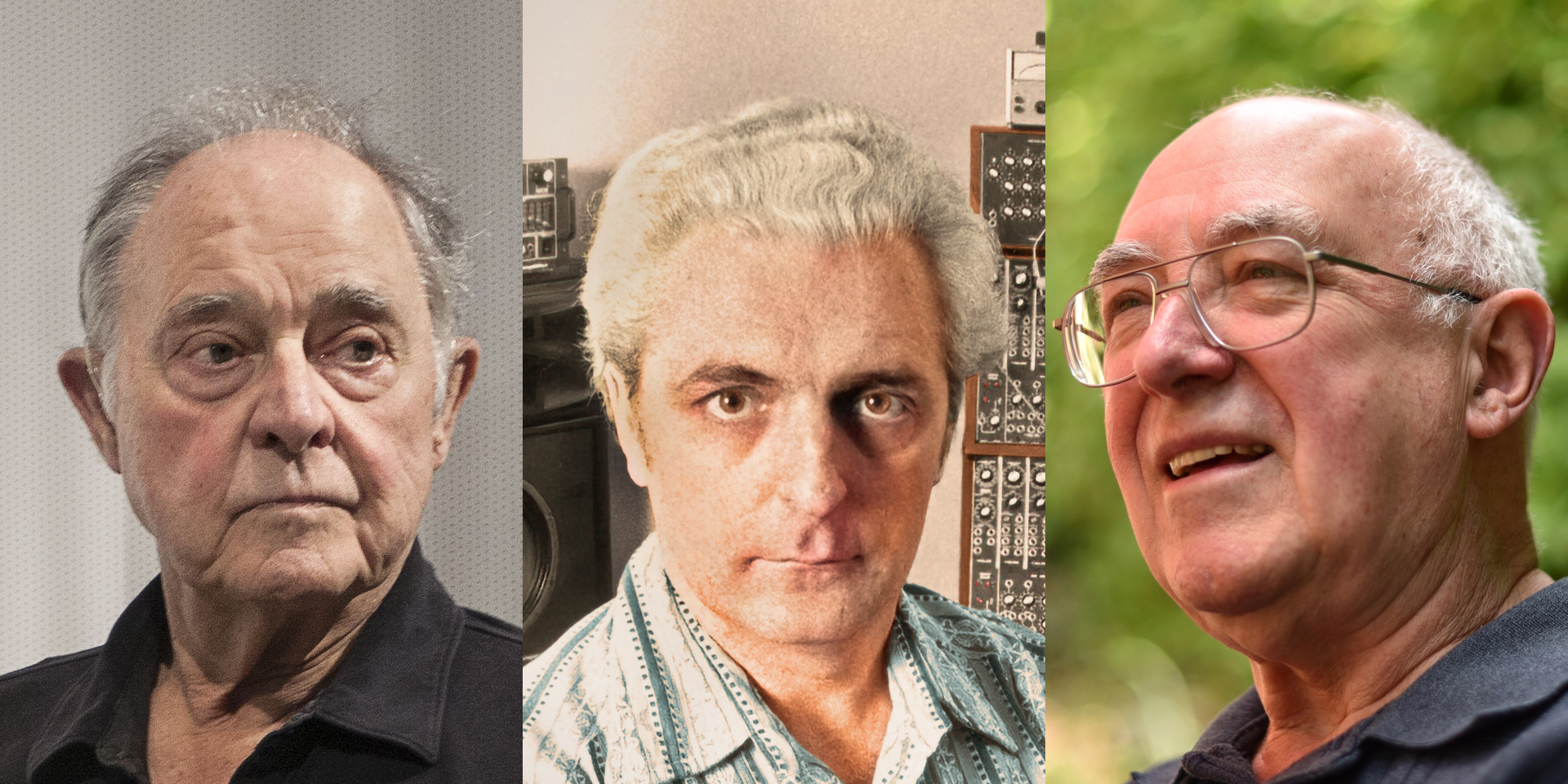
The University of Rochester’sDepartment of Sound Arts and Engineering will induct three towering figures in the history of music technology into the inaugural class of the Synth Visionaries Gallery. John Chowning, Robert "Bob" Moog, and Tom Oberheim will be recognized during an induction ceremony at the URochester campus and livestreamed at 1:30 on Thursday, September 17.
The Synth Visionaries Gallery is housed within the Department of Sound Arts and Engineering’s synthesizer lab — a collection of more than 70 instruments, some designed by URochester graduates themselves. The lab functions as a living museum of sound synthesis, where students can explore and engage directly with the technology while learning the history of electronic instruments and the contributions of the pioneers who shaped the field. The Synth Visionaries Gallery extends that mission, offering a permanent, public recognition of the inventors, engineers, and musicians whose work built the foundation of electronic music.
“The University of Rochester is proud to honor these three giants of music technology,” said Mark Bocko, chair of Sound Arts & Engineering. “Bob Moog, John Chowning, and Tom Oberheim didn’t just build instruments — they gave generations of musicians and engineers new ways to imagine sound itself. Their work continues to inspire our students every day in the synthesizer lab, and it’s a privilege to give their contributions the permanent recognition they deserve.”
About the Inaugural Inductees
Robert “Bob” Moog — transformed audio engineering by making electronic sound synthesis a practical, expressive musical medium. In the 1960s, he developed the Moog synthesizer — one of the first widely usable voltage-controlled modular systems. His designs introduced one-volt-per-octave keyboard control of oscillators, voltage-controlled filters, envelope generators, and patchable signal routing, principles that remain foundational to synthesizer architecture today. His work made electronic instruments more accessible to musicians and composers, shaping popular music, film scoring, experimental music, and later digital instrument design. His ladder filter design set a standard for tone shaping still studied and emulated in analog and digital synthesis alike. His work continues to shape how electronic sound is designed, performed, and heard.
John Chowning — revolutionized music technology by discovering FM synthesis, a method of generating rich, complex timbres by modulating one audio frequency with another. Working at the Stanford AI Lab in the late 1960s, he found that this breakthrough in the synthesis of timbres provided a very simple yet elegant way of creating and controlling time-varying spectra. In 1974, Stanford licensed the algorithm to Yamaha, whose DX7 synthesizer, released in 1983, became one of the best-selling instruments in history and defined the sound of 1980s popular music. In 1975, Chowning and colleagues founded Stanford’s Center for Computer Research in Music and Acoustics (CCRMA), establishing it as a leading center for computer music research. His work also pioneered digital sound spatialization, shaping how computers position sound in three-dimensional space. In January, he received the 2026 Technical Grammy Award for his discovery and development of FM synthesis.
Tom Oberheim — transformed electronic music by engineering some of the first practical polyphonic synthesizers. After founding Oberheim Electronics in 1969, he introduced the Synthesizer Expander Module (SEM), then combined multiple SEMs into the Four Voice and Eight Voice, among the earliest commercially available polyphonic synthesizers. His Programmer added digital patch memory, letting musicians recall sounds instantly rather than reprogramming patch cables by hand. Through the 1980s, Oberheim’s OB-X, OB-Xa, and OB-8 synthesizers, along with the DMX drum machine and DSX sequencer, defined the analog sound of new wave, synth-pop, and early hip-hop. His designs prioritized expressive performance control, warm analog tone, and workflow speed, principles still central to synthesizer design today. Decades later, Oberheim continues developing new instruments under his own name.
The Department of Sound Arts and Engineering (SAE) brings together two of the University of Rochester’s world-class schools–the Eastman School of Music and the Hajim School of Engineering & Applied Sciences–to form an integrated department that advances research, education, creative practice, and public engagement at the nexus of sound, technology, and the musical arts.
Induction Ceremony Details:
- Date and Time: 1:30 p.m. on Thursday, September 17, 2026
- Location: University of Rochester, Computer Studies Building (CSB), Room 616 — open to the public
- Livestream: The ceremony and speaker sessions will be streamed live on Zoom for those unable to attend in person.