
Granular Impact and Intrusion under Low-Gravity Conditions
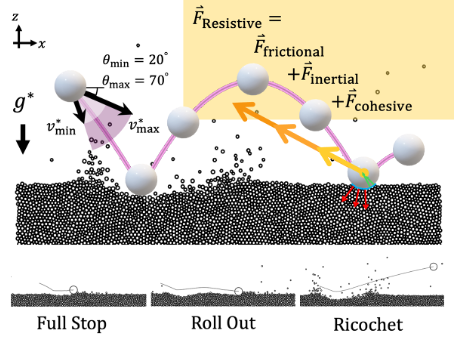
High-velocity impacts on asteroids eject boulders and fragments that may later return to the surface along low-angle trajectories at velocities of only a few meters per second. Spacecraft, landers, and sampling mechanisms can experience similarly complex interactions with loosely consolidated surface materials. Although high-velocity, nearly normal impacts have been studied extensively, the mechanics governing low-speed oblique impacts remain less well understood, particularly under the weak gravitational conditions of the Moon and small planetary bodies. My group investigates how objects ricochet, roll along the surface, penetrate, or come to rest after impacting granular materials.
My group combines reduced-order theory with discrete-element method simulations to identify the mechanics governing these outcomes. This work builds on my earlier development of resistive force theories for granular intrusion and extends these ideas to dynamic, oblique impacts. Our computational studies resolve both the motion of the impactor and the underlying evolution of the granular bed, including changes in packing, grain motion, contact forces, and force-chain structure. These internal quantities are difficult to measure systematically in experiments, but are essential for understanding how momentum is transferred from an impacting object to the granular material. We conducted hundreds of discrete-element simulations under Earth-, lunar-, and Bennu-like gravitational conditions. These simulations classified impact outcomes into three principal regimes: ricochet, roll-out, and full stop. We found that ricochet occurs primarily at higher Froude numbers and shallower impact angles, whereas full-stop behavior dominates at lower Froude numbers and steeper angles; roll-out forms a transitional regime between them. Importantly, scaling the impact conditions using the Froude number produced a collapse of trajectories and outcome boundaries across widely different gravitational environments. Dynamic resistive force theory provided a reduced-order mechanical explanation for this collapse and clarified the competition among gravity, granular resistance, and impact inertia.
This framework enables extrapolation of the behavior observed under accessible conditions to gravitational environments that are difficult or expensive to reproduce experimentally. It can also guide the selection of impact velocities, angles, particle properties, and measurement strategies for reduced-gravity experiments. More broadly, the work provides predictive tools for understanding ejecta recontact, boulder mobility, lander interactions, and sampling operations on planetary surfaces.
Building on the cohesionless framework, we are now extending this research to cohesive granular materials, for which interparticle forces become increasingly important as gravity decreases. This work examines how cohesion interacts with friction and inertia to alter impact trajectories and shift the boundaries among ricochet, roll-out, and full-stop behavior. Our objective is to establish scaling relations that remain valid from terrestrial conditions to small bodies, where even weak cohesive forces can dominate the granular response.