
Machine-Learning Design of Self-Complementary Snap-Fit Polymers
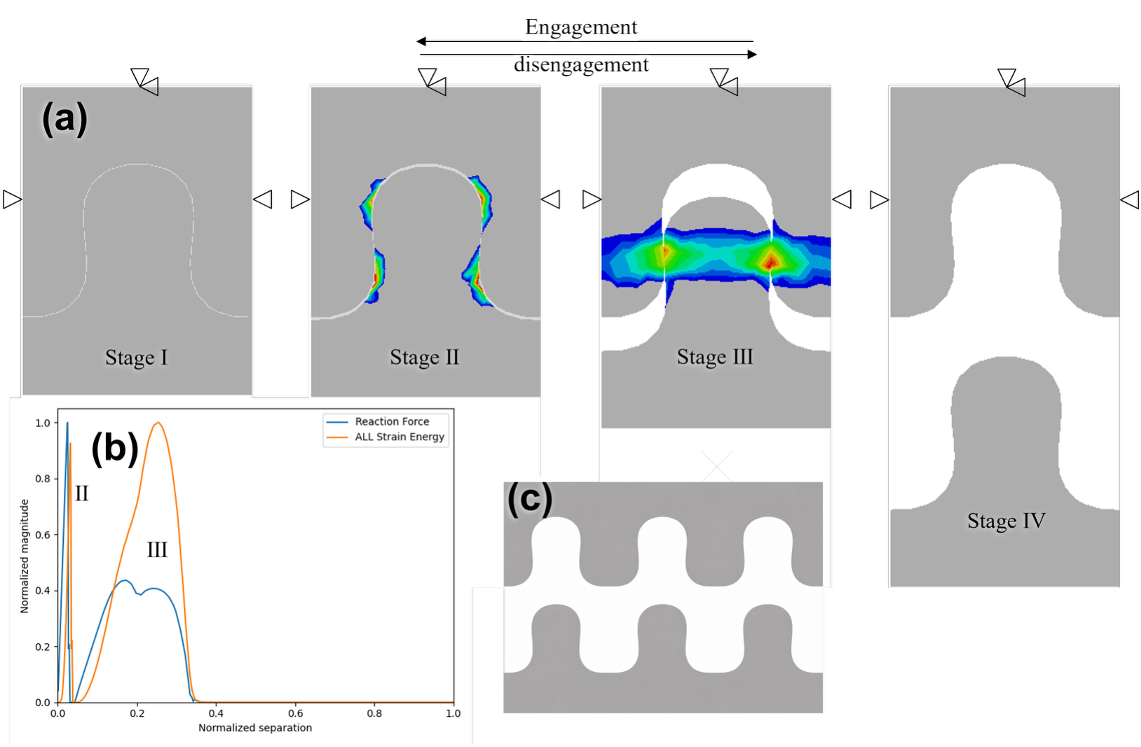 Self-complementary polymer surfaces contain repeating features that can mechanically interlock with an identical opposing surface, eliminating the need to manufacture separate male and female components. Our initial work demonstrated switchable adhesion using three-dimensionally printed, self-complementary shape-memory polymer metasurfaces. Building on this foundation, my future research will establish the mechanics and design principles governing self-alignment, insertion, interlocking, load transfer, and separation in these interfaces.
We use nonlinear finite element simulations to determine how feature geometry, spatial frequency, material stiffness, friction, and manufacturing imperfections control assembly performance. Shape-memory polymers will provide an additional control mechanism: changes in temperature can alter stiffness and contact conformity, enabling attachment, load-bearing, and on-demand release. The principal design challenge is to simultaneously minimize insertion force and stress concentration while maximizing alignment tolerance, contact area, pull-off resistance, durability, and reversibility.