
Summary
The structures of the fish fossil and the diatoms were imaged in detail and these could be used for proper identification. From the difference in observed structures, it was inferred that three different types of diatoms are present in the sample and these are termed as Type 1, Type 2 and Type 3 Diatoms.
The X-Ray spectroscopy of fish produced a high Ca peak and that of the diatoms produced high Si peaks. A high peak of gold (Au) was also produced in both the cases and it was ignored since the peak came from 300 Å gold coating. The correlation of the Ca with fish bones and the Si with the diatoms was proven by the X-Ray maps. The X-Ray maps of the fish showed absence of theSi in place of bones and concentration of the Ca in the same place. The opposite thing is observed in case of both the diatoms, where the Si concentration and the Ca depletion is noticed in place of diatoms. This proved that the fossils are not altered and would be a good source of information. In terms of interaction volume both the fish and diatoms looked the same.
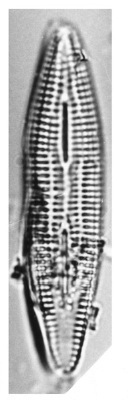
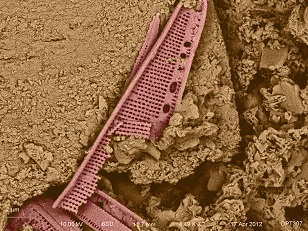
Diatom Rouxia californica ( Koizumi et al., 2009) and Type 2 diatom
identified as type 2 diatom here, could potentially be Rouxia californica, based on similarity of the structures (Koizumi et al., 2009). However, more work is necessary before solid inference could be drawn in identification of the diatoms and the fish.
References
Boudesseul, N., M. Fornari, T. Sempere, G. Carlier,M. Mamani, I. Ibarra, P. Meza, and L. Cerpa, (2000). Un importanteevento volca´nico de edadMioceno inferior en la zona de Descanso –Ayaviri – Condoroma – Santa Lucı´a (Dptos. deCusco, Puno y Arequipa),in X Congreso Peruanode Geologı´a, p. 8 and CD-ROM file GR6A (9 pp.), Geol. del Peru´ , Lima
Cerpa, L., and P. Meza (2001). Las cuencas neogenas del sur del Peru´ : La cuenca DescansoYauri (Mioceno). Evolucio´ n sedimentolo´ gica ytecto´ nica, Tesis de gradothesis, 114 pp., Univ.Nac. San Antonio Abad del Cusco,Cuzco,Bolivia
Elger, K. (2005). Plateau-style accumulation of deformation: Southern Altiplano. Tectonics, 24(4)
Ehlers, T. a., & Poulsen, C. J. (2009). Influence of Andean uplift on climate and paleoaltimetry estimates. Earth and Planetary Science Letters, 281(3-4), 238-248.
Koizumi, I., Sato, M., & Matoba, Y. (2009). Age and significance of Miocene diatoms and diatomaceous sediments from northeast Japan. Palaeogeography, Palaeoclimatology, Palaeoecology, 272(1-2), 85-98. Elsevier B.V.
Garzione, C., Molnar, P., Libarkin, J., & Macfadden, B. (2006). Rapid late Miocene rise of the Bolivian Altiplano: Evidence for removal of mantle lithosphere. Earth and Planetary Science Letters, 241(3-4), 543-556.
Garzione, C. N., Hoke, G. D., Libarkin, J. C., Withers, S., MacFadden, B., Eiler, J., Ghosh, P., et al. (2008). Rise of the Andes. Science, 320(5881), 1304-7.
Gregory-Wodzicki, K.M., McIntosh, W.C., Velasquez, K., (1998). Climatic and tectonic implications of the late Miocene Jakokkota Flora, Bolivian Altiplano. Journal of South American Earth Sciences, 11, 533–560.
Gregory-Wodzicki, K.M.,(, 2000), Uplift history of the central and northern Andes: a review. Geological Society of America Bulletin 112, 1091–1105.
Insel, N., Poulsen, C. J., Ehlers, T. a., & Sturm, C. (2012). Response of meteoric δ18O to surface uplift — Implications for Cenozoic Andean Plateau growth. Earth and Planetary Science Letters, 317-318, 262-272. Elsevier B.V. doi:10.1016/j.epsl.2011.11.039
Mcquarrie, N., Horton, B., Zandt, G., Beck, S., & Decelles, P. (2005). Lithospheric evolution of the Andean fold-thrust belt, Bolivia, and the origin of the central Andean plateau. Tectonophysics, 399(1-4), 15-37.
Poulsen, C. J., Ehlers, T. A., & Insel, N. (2010). Onset of Convective Rainfall During Gradual Late Miocene Rise of the Central Andes. Science, 328(April), 490-493.
Acknowledgements
Many thanks to Brian Mcintyre for his help in every stage of the project. Special thanks to Donnell Jackson, Sergey Korjenevski and Nilotpal Ghosh for helping out with different problems in the lab and to Gerry Kloc for his help in the sample preparation. Lastly, I would also like to thank my advisor Carmala Garzione for her active support in the project.