Introduction
What is a piezoelectric?
Generally, a piezoelectric material is a material that expands and contracts when a voltage is applied to it. This is sometimes called the inverse piezoelectric effect. The opposite is also true: squeezing a piezoelectric generates an electric charge, and this is called the piezoelectric effect. All of this is on a very small scale, though: a piezoelectric crystal might move as little as a thousandth of an inch or less! Because of this, piezoelectrics can be used to convert mechanical energy (like sound or motion) into electrical signals, and vice-versa. You can think of a piezoelectric as both a microphone and a speaker at the same time-- in fact, piezoelectrics are sometimes used in microphones and speakers.
Piezoelectrics, Ferroelectrics, and PMN-PT
I'm studying one new kind of piezoelectric called lead magnesium niobate-lead titanate. Its chemical formula is  . It's called PMN-PT for short. Here, the x stands for the relative amount of the lead titanate or PT component. PMN-PT is important because it's a much better piezoelectric material than what we use today. For example, substituting PMN-PT for existing piezoelectrics would make ultrasound pictures much clearer and sharper, allowing doctors to better diagnose and treat many illnesses.
PMN-PT actually belongs to a family of piezoelectric materials called ferroelectrics. (In fact, PMN-PT is even a special kind of ferroelectric called a relaxor ferroelectric.) The piezoelectric effect happens in ferroelectrics such as PMN-PT due to their unusual crystal structure.
In most crystal structures, the atoms of the material are arranged in a regularly spaced lattice. Normally, the lattice is very repeated and symmetric. For example, a simple cubic lattice looks just like many cubes of atoms stacked together, like this:
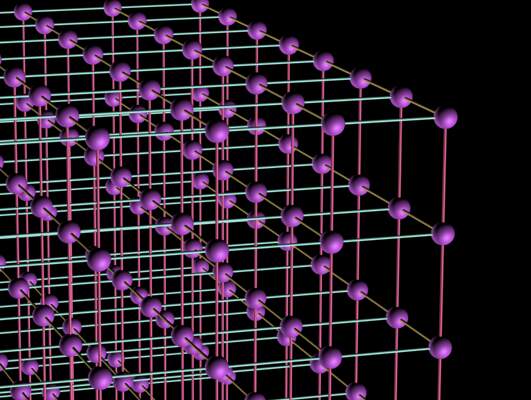
In this picture the atoms are arranged in regular cubes, but in a real crystal they might be arranged in other ways (as you'll see below). But, there is always a small part of the lattice that can be repeated regularly to get the whole lattice. This small part is referred to as the unit cell of the lattice. Of course, for the cubic lattice, the unit cell is a cube!
Sometimes, a cubic lattice has an atom at the center of each cube as well. This is called body-centered cubic. In a ferroelectric crystal like PMN-PT, that central atom has a charge (it's an ion). In ferroelectric crystals, the central ion is normally unstable at the center of the unit cell and naturally "wants" to shift slightly off-center in some direction, which distorts the cube by stretching it a little bit. Then the lattice isn't really cubic any more, but it's still very close to cubic and this is sometimes called "pseudo-cubic".
An electric field could pull that off-center ion farther off-center, stretching the lattice more, or push the ion more towards the center, relaxing the lattice. In this way, the electric field changes the size of the whole crystal. Squeezing or pulling on the crystal would also shift that ion, causing charge to build up and produce an electric field. This is where piezoelectric effects come from!
Phases
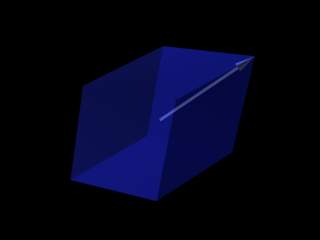
PMN-PT is a ferroelectric, so at room temperature it is naturally pseudo-cubic: the cubic lattice is not cubic at all! Instead, the lattice has another shape, and what shape this is depends on its composition. For x < 25%, the structure is rhombohedral. That's formed by stretching the cube along its diagonals, or by moving the center ion of the unit cell towards one corner, like this:
You can see that there are eight different ways to do this:
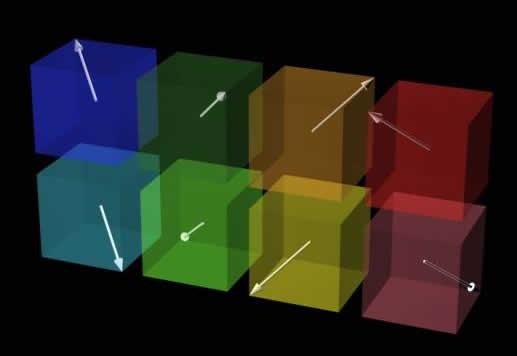
For x > 40%, the structure is tetragonal. This is equivalent to stretching a cube up & down, left & right, or front-to-back, and of course there are six ways to move the center atom to make a tetragonal structure (up, down, left, right, front, back).
These two structures, rhombohedral and tetragonal, are called phases of PMN-PT. I have some samples of PMN-PT which are supposed to have about x = 29%. At the moment, no one knows for sure what phase my samples should be. Some scientists think that the sample will be completely rhombohedral, others think that it will have a mixture of rhombohedral and tetragonal regions, and some think that instead, it will be a third kind of phase called monoclinic. Different measurement methods have given different results, so the phase composition is still a mystery. It's difficult to determine the results precisely because all of these phases are very, very close to cubic.
One way the phases can be distinguished is by looking at the diffraction patterns of a crystal, and one diffraction technique is electron diffraction in a Transmission Electron Microscope (TEM). I used this technique in my project.
The Domain Puzzle
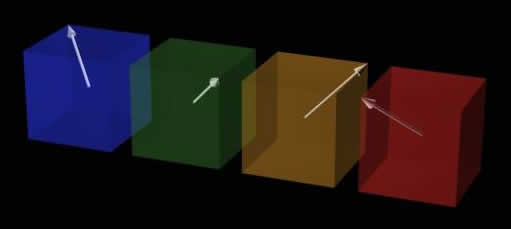
In rhombohedral PMN-PT, you can see from the picture above that there are eight different directions that the center atom can be shifted. We call these the poling directions of the crystal. In a freshly made crystal, all eight directions should exist in equal numbers. To make PMN-PT have strong piezoelectric properties, a very strong electric field is applied in one direction, realigning some of the poling directions permanently. This is called poling the crystal. After poling, the poled cells all work together in one direction, making the piezoelectric effect in that direction much stronger.
However, poling doesn't mean only one direction is left! For example, if the crystal is poled upwards, then all of the lower four poling directions would turn to point upwards and stay pointing upwards. But they would still point in all four different upwards directions, like this:
In a real crystal, there are regions where many unit cells together all point in the same direction spontaneously. These regions are called domains. Each domain has its own poling direction and its own shape and size. Here is a picture of a layer of unit cells. You can see how they are grouped into domains:
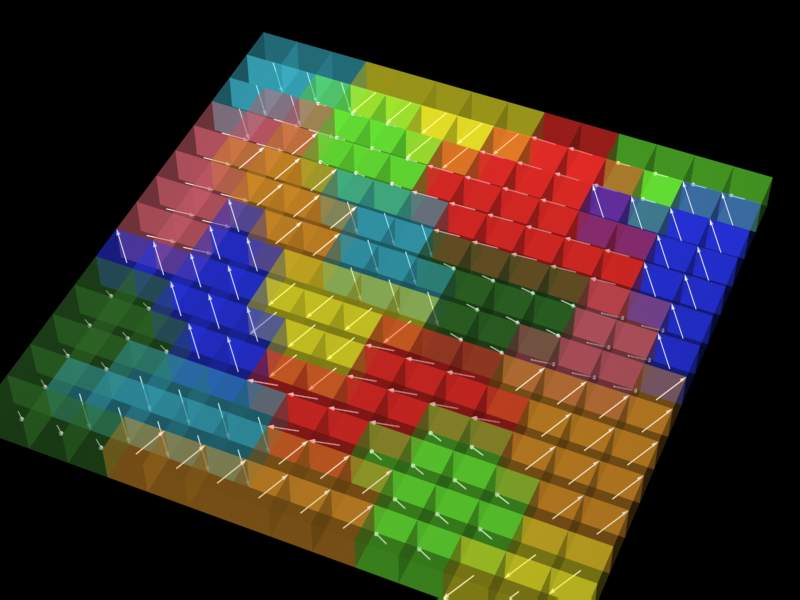
Depending on how two neighboring domains are aligned, they might be working for or against each other when they expand and contract. If they conflict, this can cause stress and the crystal may be weaker. So, if we want to understand how to make the crystals stronger, we need to understand the domains very well. Here are some important questions:
How big are the domains?
What are their poling directions?
How can domains be changed or re-oriented?
Previous studies have found that domains on the surface of a crystal can be as small as a few nanometers, and as large as 10-20 micrometers long and 2-5 micrometers wide. We know that domains can be changed by applying a strong electric field (the process used in poling) and also by lots of physical stress.
One way domains can be studied is through etching. If you put a sample in acid, the acid will attack "down" domains more than "up" domains, producing a relief pattern that mimicks the up-and-down orientations of the poling directions. The domain picture above might etch like this:
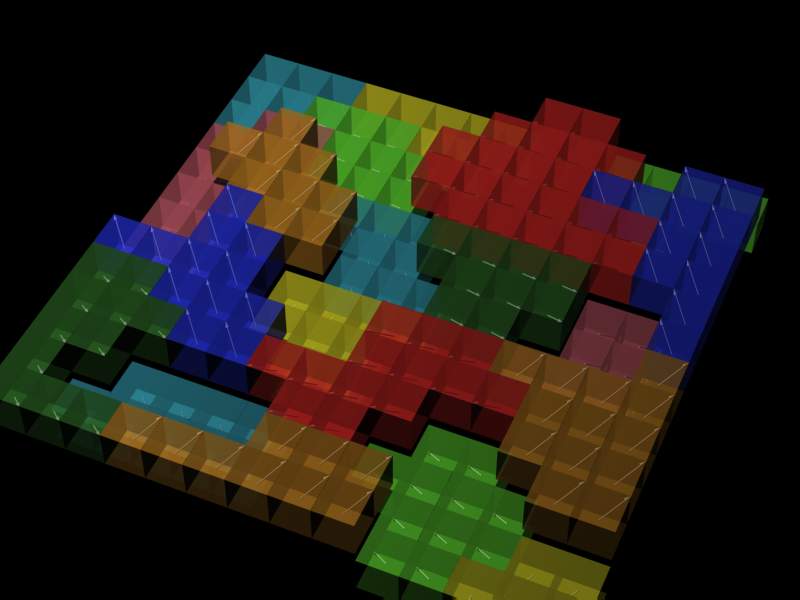
A drawback to this is that the etching can take one or two days! A slightly different approach is to polish the sample using a fine slurry and a slightly acidic (or basic) fluid. The mechanical polishing can speed up the etching process significantly, but does it produce the same effect? The final relief pattern can be studied using a normal optical microscope in DIC (Differential Interference Contrast) mode, but there's no guarantee that the relief pattern accurately reflects the domains at the surface.
Domains at the surface produce positive and negative charge regions corresponding to up and down poling. These charges could affect the path of electrons in the SEM (Scanning Electron Microscope) and make the regions appear brighter or darker. In this way the SEM could reveal the domain patterns before etching, providing confirmation that that mechanical etching does reveal the true domain structure. I used these techniques in my project.
A final way to look at domains might be to study the composition of the material. Crystals of PMN-PT are grown in a furnace above 1100ºC (2012ºF)! Domains form when the crystal is cooled below about 130ºC (266ºF), which is called the Curie temperature.. (The Curie temperature changes with the composition, and for (1-x)PMN-xPT it gets higher as x increases.) It's not clear just why domains form when and where they do, but variations in the chemical composition of the material could probably affect it. So studying how the chemical composition varies in the sample might give a hint about how the domains will form. For this kind of study, X-ray composition analysis using EDAX on the SEM is promising, and I used this technique in my project.
You can go to:
Home Page
- Introduction - A basic overview of some of the concepts important in this work. This section was written to be more accessible to the general reader, while the later sections assume more technical knowledge.
- X-ray Mapping - Using X-ray analysis to look for ferroelectric domains.
- TEM Electron Diffraction - Studying the phases of PMN-PT using electron diffraction.
- SEM Domain Hunting - Looking for ferroelectric domains using a combination of SEM, mechanical etching, and DIC optical microscopy!