
To see if the domain structure of PMN-PT is related to compositional variations, I examined an unpoled single crystal using an X-ray analysis mapping technique with the scanning electron microscope. This involves hitting the sample with a high-energy (25 KeV) electron beam. When hit by these electrons, different elements in the sample give off X-rays of characteristic energies (or "colors"). By using a detector to monitor the spectrum of X-rays and a computer to analyze the results, it is possible to accurately measure the chemical composition of the sample.
For this test I used an unpoled sample at a magnification that was approximately correct to see micrometer-sized domains. The sample was well-grounded and the top was coated with a thin (~60 nm) layer of gold to prevent charging. Electron simulations confirmed that this layer of gold probably wouldn't affect the results of the scan.
However, the simulation also showed that the resolution of the image would be limited to about a micron due to the large electron interaction volume. This should have been more than enough to see domain structure, so I ran the EDAX scan overnight. Here are the results:
Total measured intensity : 25.6 x 20 micron

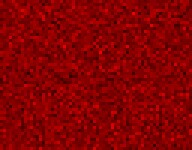
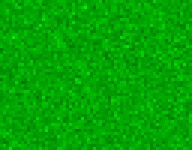
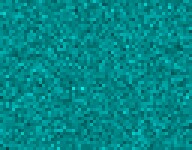
Clockwise from top left: Pb, Mg, Ti, Nb
The intensity in each picture represents the ZAF-corrected relative quantity of that element, by weight, then scaled to bring the range to the full scale. Thus the actual composition ranges represented in each picture are:
Either the sample has a widely varying composition, or more likely, the sampling time wasn't great enough to distinguish fine detail. Any possible signal is lost in sampling noise. Therefore, it seems very unlikely that domains could be revealed using this technique, unless the experimenter is prepared to spend a great deal of time running a scan.
One alternative would be to scan a single line more slowly. This would trade one linear dimension for greater sampling time. However, it would be very difficult to observe domains using only a single line scan. Therefore, I feel that this technique is inadequate for the identification of domains.