Daguerreotype TEM Sample Preparation Using
Gas Injection and Focused Ion Beam Milling

Alex Mann1, Brian McIntyre2, Ralph Wiegandt3
1URnano, Department of Physics & Astronomy
2Department of Optics, University of Rochester, Rochester, NY 14627, USA
3George Eastman House International Museum of Photography and Film, Rochester, NY 14607, USA

leftIntroductionFIB MillingSample RelocationTEM Grid WeldingCitationsHomeright

What is Focused Ion Beam milling?

While a beam of incident electrons is used to build up an image of very small features, a similar method can be employed using not electrons but, in fact, charged Gallium ions. Since these ions are much more massive than electrons, they carry with them much more energy during collisions. This extra force is used to ablate away material from a specified region much the same as sand blasting is capable of removing layers of material on a macro scale.

Daguerre
Pattern in which material was ablated (copper color) leaving the thin TEM sample (blue)

How was the TEM sample milled?

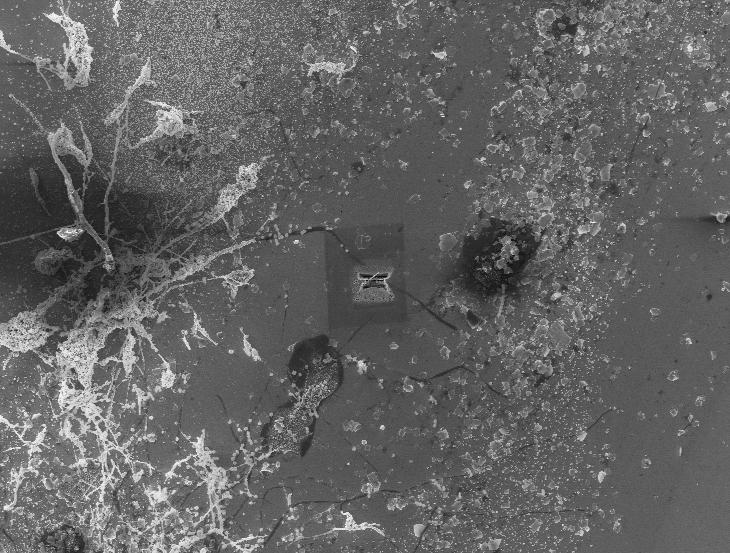
Firstly, an area of interest must be selected. For this project a sample was milled across the path of unknown biological material. The area is bounded by the grey box in the image below.

Once the area of interest has been selected the next step is to set up eucentricity. Since the SEM is equipped with a multifunctional stage, it is important that the rotational point be set to sample itself. This is controlled by "M", which is a numerical offset of the vertical height adjustment.

Eucentricity must be established before coincidence of the FIB beam (milling) and the electron beam (imaging) can be set up. While it is possible to image with the ion beam, it is not possible to do so without simultaneously ablating material. To reduce this the electron beam is shifted to scan the same region as the ion beam, so progress may be imaged non-destructively.

Since so much material is ablated away during the patterning, a bowtie shape is used, with the beam scanning in towards the center from each side. The TEM sample will be left as a thin section between the two trapezoids. This initial milling is done at relatively high current - 240nA - to quickly remove material. As the sample gets thinner, a current of 50nA (incidentally the FIB imaging current) is used to precise mill the sides of the sample. If needed, even lower currents can be employed for an even smoother polish.
 

Selected Area
The center grey box indicates the area selected for milling.

What happens after the sample is milled?

Since the TEM is obviously not capable of looking at the sample while it is still attached to the daguerreotype, it must first be extracted. To do this, it must first be cut free from the edges and its base.

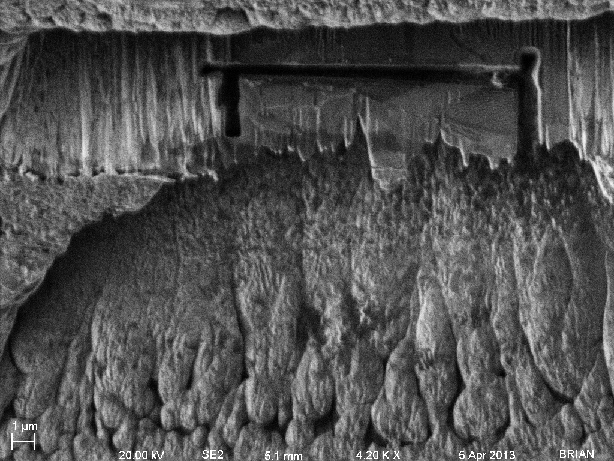
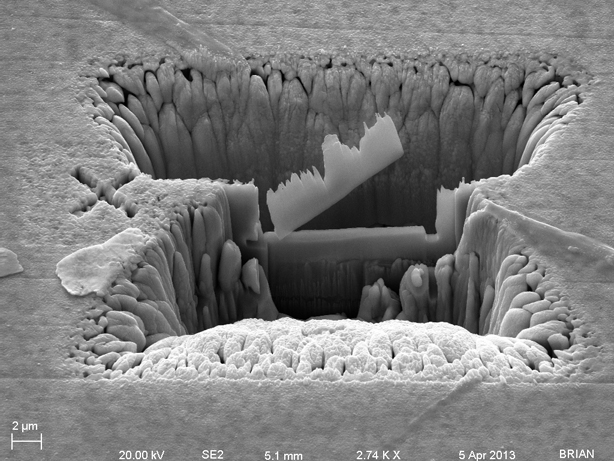
By tilting the sample, it is possible to use the same FIB beam to cut along the base and two sides of the sample to free it from the daguerreotype. Once completed, a micromanipulator was brought in to move the sample onto the TEM grid.

Release Cut
Tilted milling for release cuts


Free Sample
 Free floating sample, ready to be relocated


Please enter any comments, criticisms, questions, etc. below.

Your name:

Email address: