Student News
BME Senior Design Team Earns Second Place in 2026 DEBUT Challenge
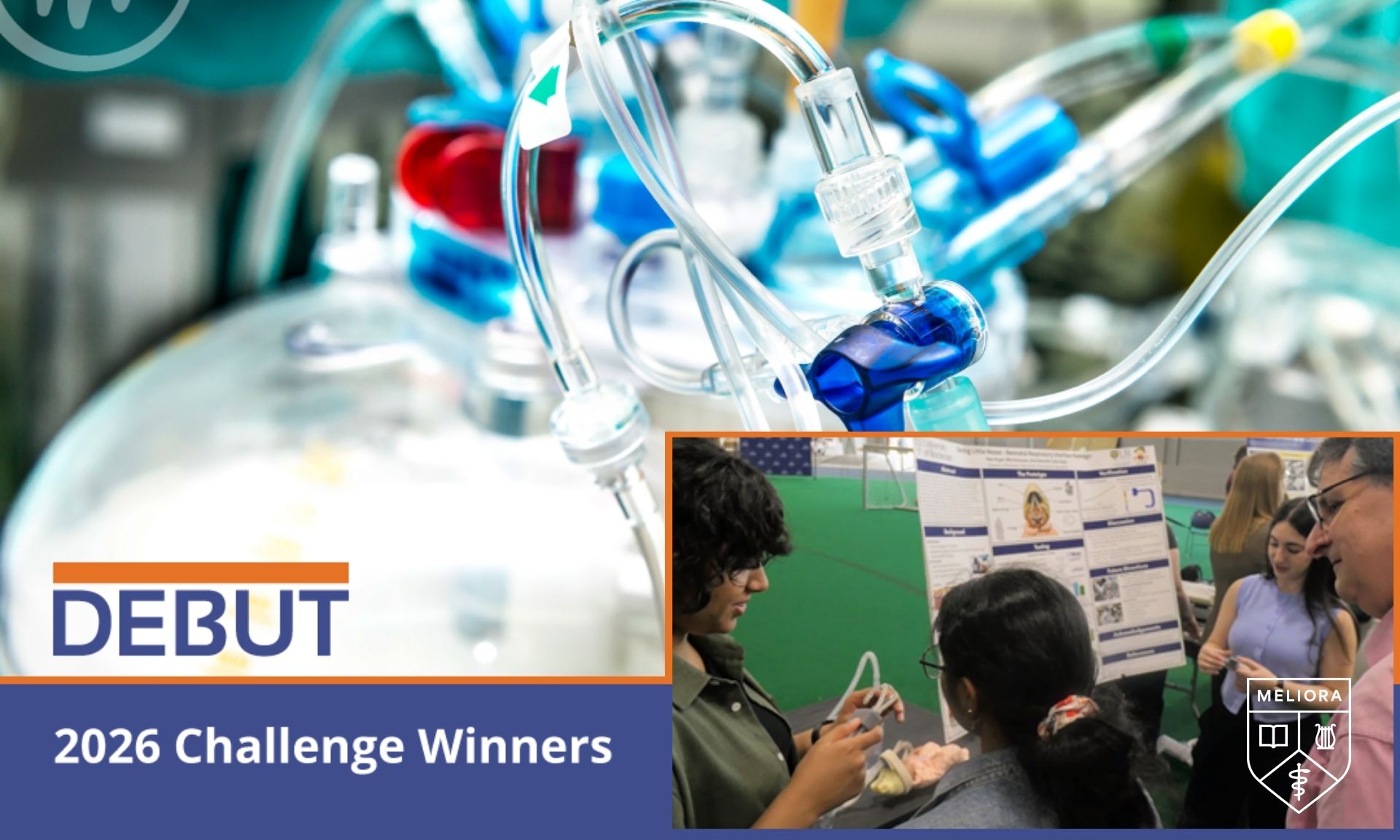
Congratulations to the 2026 BME Senior Design team behind Novel Neonatal Respiratory Support Interface on earning Second Place and a $15,000 prize in the 2026 DEBUT Challenge!
The team—Julia Rothschild, Anika Sagar, Ryan Dugan, and Nika Kazumyan—developed Ledernosen, an innovative redesign of a commonly used neonatal respiratory support interface. The project was supervised by Marisol Herrera-Perez, with Scott Seidman and Benjamin Castañeda serving as faculty instructors.
Each year, approximately 10% of infants born in the U.S. cannot breathe independently. Devices used to provide respiratory support to preterm babies often cause injuries, sometimes as extreme as permanent nasal deformity. The team’s Ledernosen prototype redesigns the commonly used Fisher & Paykel (F&P) bubble continuous positive airway pressure (CPAP) interface to reduce pressure injuries and abrasions from ill-fitting apparatuses, enabling longer-term use and easier setup. The preliminary success of Ledernosen, demonstrated by airflow and contact pressure testing, indicates significant potential to reduce injury caused by respiratory support interfaces in life-saving NICU care.
Advancing Neonatal Respiratory Support
Approximately 10% of infants born in the United States are unable to breathe independently and require respiratory support. For preterm infants, devices used to provide this support can cause pressure injuries and abrasions, with ill-fitting interfaces sometimes resulting in permanent nasal deformity.
To address this challenge, the team designed Ledernosen, a prototype redesign of the widely used Fisher & Paykel (F&P) bubble continuous positive airway pressure (CPAP) interface. Their design aims to reduce pressure injuries and abrasions caused by poorly fitting respiratory support equipment while enabling longer-term use and simplifying setup for caregivers.
Preliminary testing demonstrated promising results, including successful airflow and contact-pressure testing. These findings suggest that Ledernosen has significant potential to reduce injuries associated with respiratory support interfaces and improve care for infants receiving life-saving treatment in the neonatal intensive care unit (NICU).
Recognized Among a Highly Competitive Field
The DEBUT Challenge, funded by the National Institutes of Health’s National Institute of Biomedical Imaging and Bioengineering (NIBIB), recognizes innovative undergraduate biomedical engineering designs that address important clinical and healthcare challenges.
The 2026 competition featured 119 applications from 64 universities across 29 states, with 490 students participating. Earning second place among such a strong national field is an outstanding accomplishment and a testament to the team’s creativity, technical expertise, and commitment to improving neonatal care.
We are incredibly proud of the team and their innovative work to advance neonatal respiratory support!
🎥 Watch a video to learn more about the team’s research and the development of Ledernosen.
🔗 Read more about the project at the DEBUT Challenge website
LinkedIn Accounts:
- Julia Rothschild
- Anika Sagar
- Ryan Dugan
- Nika Kazumyan
- R. Marisol Herrera-Perez
- Scott Seidman
- Benjamin Castañeda
- BME Department's social media accounts: