|
HOME
Introduction
Methodologies
Summary
Acknowledgement
Feedback
|
Introduction
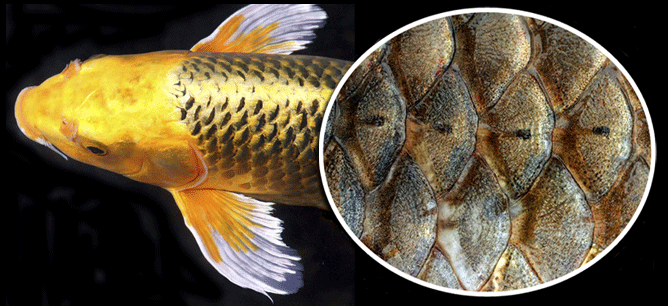 As seen on most fish in
supermarket, such as salmon, bass, red
snapper and so on, fish scales are very
common. The outer body of fish is covered
with scales, which are part of the fish's
integumentary system. However, have you ever
noticed that the shape and color of scale
differ from one fish to another? Actually,
the use of scale morphology for fish
classification, also known as lepidology,
can be tracked back to the middle of
nineteen century. Agassiz, a Swiss
palaeontologist, was the first one to use
fish scales for taxonomy. In his work, he
divided fishes into four groups according to
the structures of their scales: Placoidei,
Ganoidi, Ctenoidei, and Cyloidei. As seen on most fish in
supermarket, such as salmon, bass, red
snapper and so on, fish scales are very
common. The outer body of fish is covered
with scales, which are part of the fish's
integumentary system. However, have you ever
noticed that the shape and color of scale
differ from one fish to another? Actually,
the use of scale morphology for fish
classification, also known as lepidology,
can be tracked back to the middle of
nineteen century. Agassiz, a Swiss
palaeontologist, was the first one to use
fish scales for taxonomy. In his work, he
divided fishes into four groups according to
the structures of their scales: Placoidei,
Ganoidi, Ctenoidei, and Cyloidei.
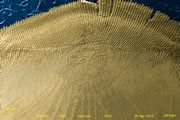
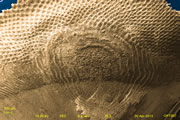
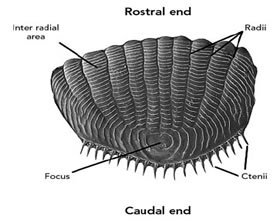 The
left figure is showing the descriptive
terminology of a typical fish scale. Each
category of fish possesses different
characteristics, for instance, ctenii,
radii, and inter radial pattern. Here, I
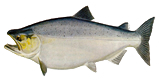
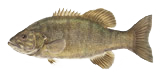
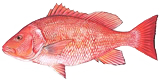
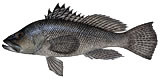
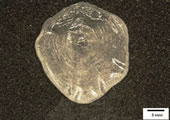
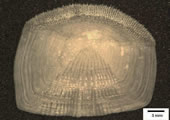
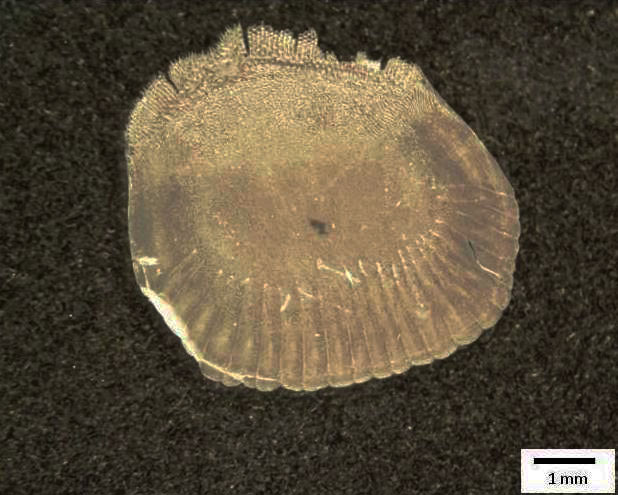
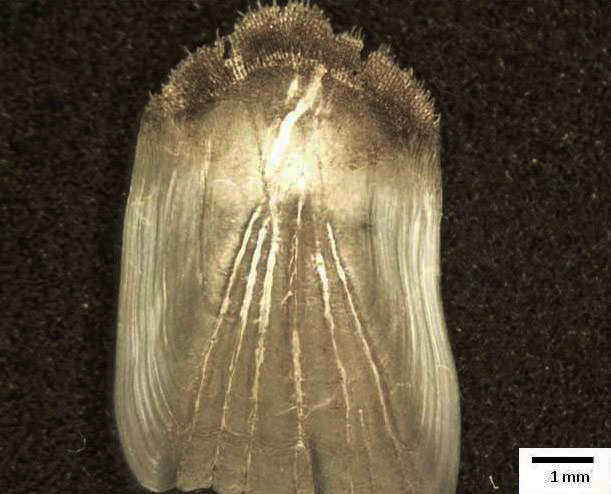
pick up some scales from four kinds of fish,
as seen above, salmon, striped bass, red
snapper, and sea bass, to look into the
morphology and materials. Thanks to the
electron microscope, a fantastic microworld
is awaiting. Ready? Let's scale it up! The
left figure is showing the descriptive
terminology of a typical fish scale. Each
category of fish possesses different
characteristics, for instance, ctenii,
radii, and inter radial pattern. Here, I
pick up some scales from four kinds of fish,
as seen above, salmon, striped bass, red
snapper, and sea bass, to look into the
morphology and materials. Thanks to the
electron microscope, a fantastic microworld
is awaiting. Ready? Let's scale it up!
Methodologies
Seven methods are involved in this project:
1. Light Microscopy: traditional light
microscopy equipped with laser 3-D scanning.
2. Scanning Electron Microscopy (SEM):
�obtaining the morphology of sample.
3. Sputter Coating: making the biology sample
conductive for SEM analysis.
4. Atomic Force Microscopy (AFM): measuring
the height of different scale patterns.
5. Energy Dispeprsive Spectroscopy (EDS):
carrying out the accurate elemental analysis
for scale samples.
6. Backscattered Electron (BSE) imaging:
giving general elemental information of sample
in a contrast picture.
7. Colorization: using photoshop to colorize
SEM greyscale images to make them visually
appealing by photoshop.
8. Panorama image assembling: more than 30
micrographs are taken to assemble to a
panorama image for the scale sample.
Summary
Acknowlwdgement
I would like to
express my gratitude to Brian L. McIntyre for
giving such a wonderful course of Opt307. I
would also like to thank our TA, Rohit for the
great help with this project. I am grateful to
Suju Gurung, Maria Abreu-Sepulveda, and Xiang
Li for their inspiring duscussion and advice.
Reference
[1]Laith
A. Jaward Comparative scale morphology and
squamation patterns in triplefins (Pisces:
Teleostei: Perciformes: Tripterygiidae).
Tubinga (2005)16: 137-167.
[2]http://en.wikipedia.org/wiki/Fish_scale
Feedback
|