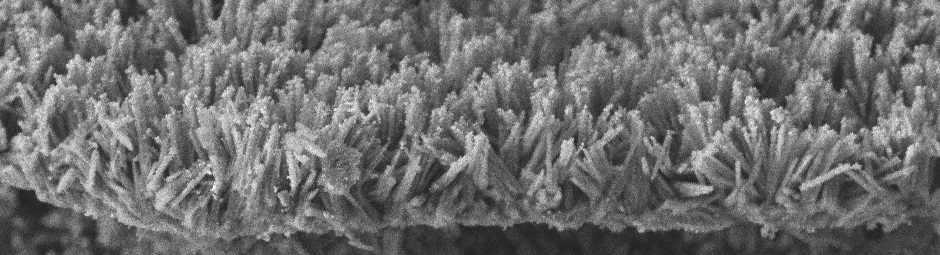
X-Ray Microanalysis
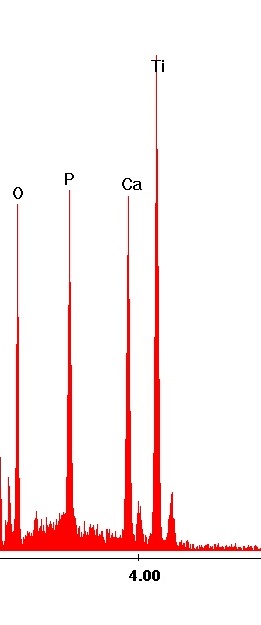
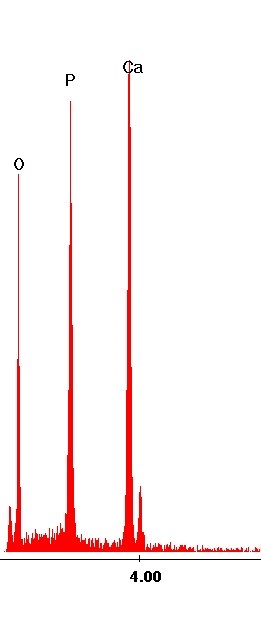
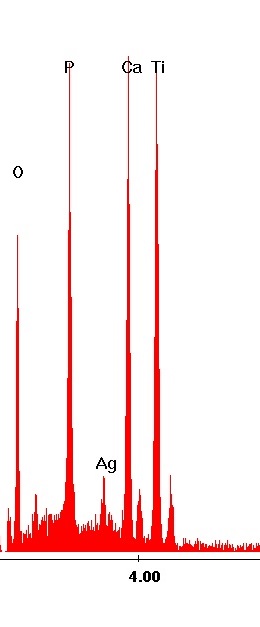
Energy Dispersive Spectra (EDS) were used to analyze the elemental composition of each of the four types of samples. Peaks were identified within the EDAX software and were verified based on knowledge of hydroxyapatite (calcium phosphate crystal) and the deposition process (includes use of sodium chloride and silver nitrate). Occassionally, the EDS would register Na and/or Cl within the sample; this was deemed to be residue on the surface of the crystals from the salt in the deposition solution and was ignored if present.
 |
 |
 |
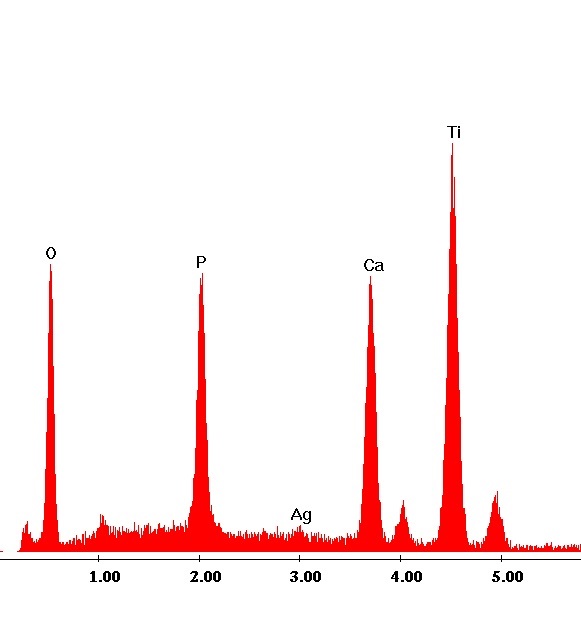 |
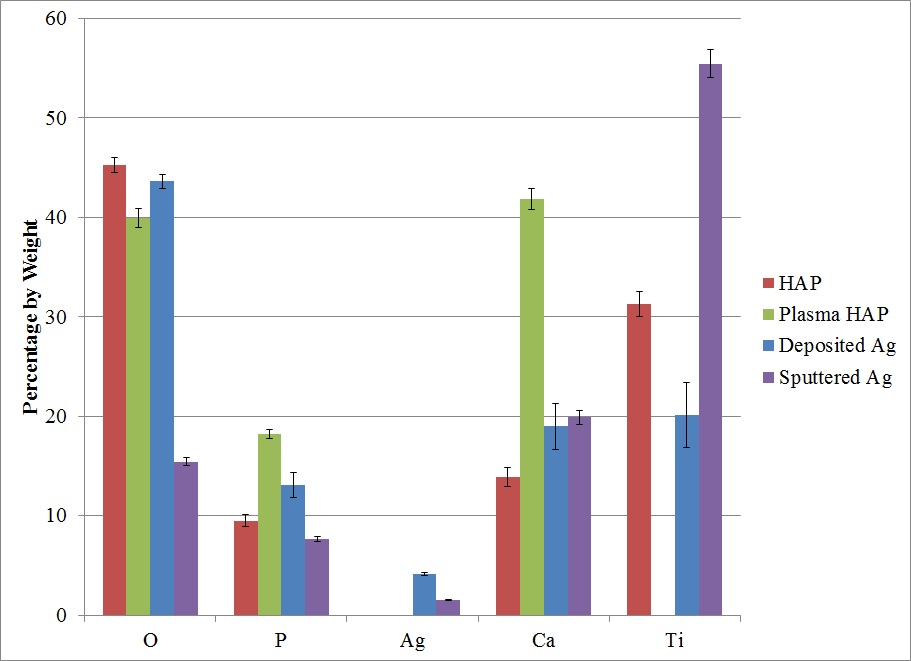
The spectra indicate that indeed all the coatings include O, P, and Ca, the main elements in hydroxyapatite. The presence of a Ti peak in all but the plasma sprayed HAP sample suggests that the electrochemically deposited HAP coating is so thin that the beam's interaction volume includes some aspect of the titanium substrate beneath, whereas the plasma sprayed HAP coating is much thicker. Finally, the presence of a Ag peak is anticipated and observed on the two samples where an attempt was made to add silver to the coating. In addition, using the EDAX software, the relative abundance (percentage by weight and percentage by atomic amount) of each element within each sample was calculated and the average values of those categories are shown below.
 |
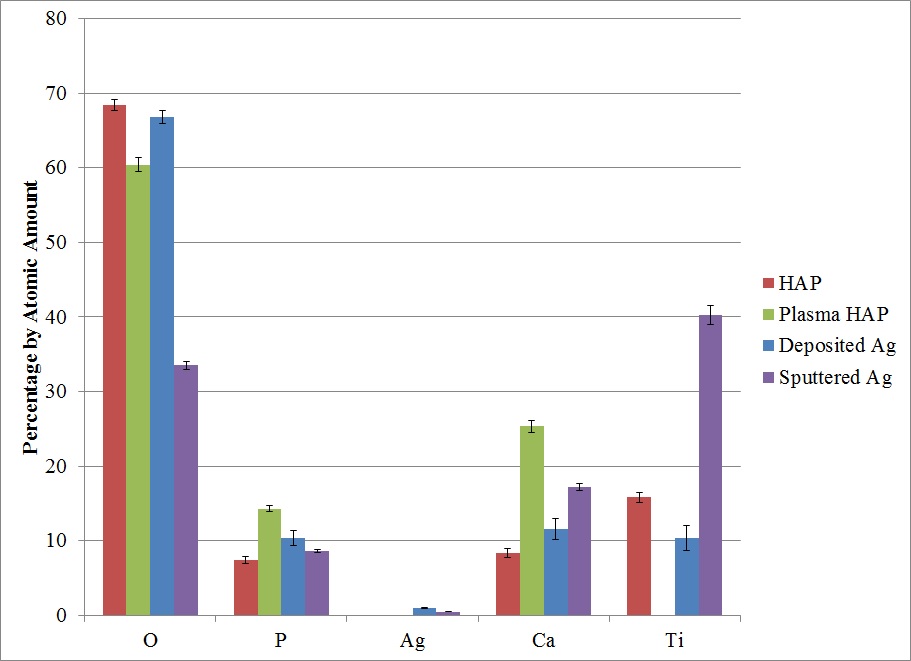 |
The above data indicates that EDS observes a much higher abundance of silver, particularly in relation to the abundance of P and Ca from the HAP, in the electrochemically deposited silver samples as opposed to the sputtered silver samples.
| Ag:O (Wt%) | Ag:P (Wt %) | Ag:Ca (Wt %) | |
|---|---|---|---|
| Deposited Ag | 0.095 | 0.32 | 0.22 |
| Sputtered Ag | 0.099 | 0.20 | 0.077 |
Using the relative atomic abundances of the elements, in particular, P and Ca, the exact chemical make-up of the crystal structure can be explored. Hydroxyapatite should have three Ca atoms for every 5 P atoms, but it has been know to vary widely from this ideal when in crystal structures such as this HAP coating. Not surprisingly, plasma sprayed HAP is much closer to this ideal, whereas the HAP created from electrochemical deposition is Ca deficient due to the process. One should expect HAP, Depositied Ag, and Sputtered Ag to be identical since the Ca and P all come from the same HAP structure, however, surprisingly, the sputtered Ag samples deviate radically. This points to the large amount of error and variability which exists in X-ray microanalysis of rough samples like these with large amounts of free space (very non-ideal, non-homogenous calculation conditions).
| Ca:P (At %) | |
|---|---|
| Ideal HAP | 1.67 |
| HAP | 1.13 |
| Plasma HAP | 1.78 |
| Deposited Ag | 1.12 |
| Sputtered Ag | 2.00 |