
URochester expands research on quantum matter under extreme conditions
Rip Collins secures $3 million grant from Department of Energy to explore how immense pressure can produce unexpected quantum behavior.
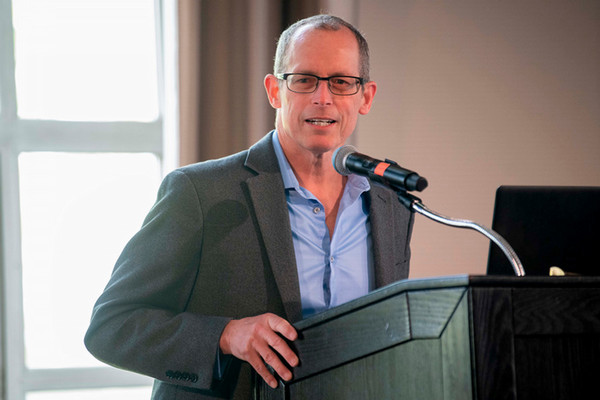
The University of Rochester has received $3 million in new funding from the US Department of Energy (DOE) Office of Science to expand research on quantum matter under extreme conditions.
Led by Gilbert “Rip” Collins, the Tracy Hyde Harris Professor of Mechanical Engineering and Physics and Astronomy and the Associate Director of Science, Technology and Academics at the Laboratory for Laser Energetics, the team will squeeze materials to extraordinary densities, where electrons (and ions) coherently interact to produce new states and properties of matter. The award enables researchers to explore new ways that crushing pressure can unlock quantum behavior at temperatures far higher than scientists would ordinarily expect.
“High-energy-density science gives us new ways to explore quantum behavior,” Collins says. “By controlling the pressure, temperature, fields, and composition of materials, we can investigate states of matter that have been inaccessible through conventional experiments.”
The funding brings total DOE support for the URochester-led effort to more than $9 million.
Scientists traditionally study quantum properties at very low temperatures. Collins and the extreme quantum team will use powerful lasers to compress materials for brief periods, then pair measurements with theory and computational tools to investigate whether pressure can produce such properties at much higher temperatures as well as altogether new quantum materials and behavior. Because laser compression creates these exotic states for only fractions of a second, the researchers use theoretical calculations to identify promising conditions and determine what to measure before conducting experiments.
Hydrogen-rich materials are one key area of focus. The team will investigate whether the extreme compression of hydrogen or hydrogen-containing compounds produce key quantum coherent properties, including topological behavior or potential superconductivity, in which a material conducts electricity without resistance.
The researchers will also examine other materials under extreme pressure, temperature, magnetic fields, and changes in composition to predict new states of matter and effects under extreme conditions.
Collins leads the effort with scientists from the University of Illinois-Chicago, University of Utah, University at Buffalo, University of Edinburgh, Lawrence Livermore National Laboratory, together with researchers at URochester in the Departments of Mechanical Engineering, Physics and Astronomy, and the Laboratory for Laser Energetics. Their combined work connects the creation and measurement of extreme conditions with models of how materials behave. The team combines expertise in extreme matter experiments, quantum materials, theory, and computation.
The DOE award will support a postdoctoral scholar and three graduate students at URochester each year, as well as students and postdoctoral researchers at partnering institutions, giving them opportunities to work across experiments, theory, and computation.