
Colloquia & Guest Speakers
Space-Time Duality in Optics: Its origin and Applications
Professor Govind Agrawal, Dr. James C. Wyant Professor of Optics, Professor of Physics, Distinguished Scientist, Laboratory for Laser Energetics, Institute of Optics
Monday, February 23, 2026
3:30 p.m.
Presented in-person in Goergen 101 and on Zoom
Abstract
The concept of space-time duality, known since the 1960s, is attracting attention in recent years in the context of temporal imaging. In this talk I first review this topic and discuss how a time lens can be used for optical signal processing in a variety of applications.
I then focus on my group’s work on the temporal analog of reflection and refraction of optical pulses inside a dispersive medium with a temporal boundary across which the refractive index changes. As an optical pulse approaches this boundary, it splits into two parts that propagate at different speeds because of their widely different spectra. An analog of total internal reflection also occurs when the refractive index change at the boundary is large enough. This phenomenon can be used to make a temporal waveguide that confines optical pulses within a temporal window. I also discuss how the nonlinear phenomenon of cross-phase modulation can be used for making such a temporal waveguide by employing a pump-probe configuration.
Biography
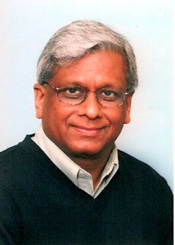
Govind Agrawal received the MS and PhD degrees from the Indian Institute of Technology, New Delhi, in 1971 and 1975 respectively. After holding positions at the Ecole Polytechnique, France, the City University of New York, and Bell Laboratories, Murray Hill, NJ, Dr. Agrawal joined in 1989 the faculty of the Institute of Optics at the University of Rochester, where he is James C. Wyant Professor of Optics. His research interests focus on optical communications, nonlinear optics, and silicon photonics. He is an author or coauthor of 10 books and more than 500 research publications. His books on Nonlinear Fiber Optics (Academic Press, 6th ed., 2019) and Fiber-Optic Communication Systems (Wiley, 5th ed., 2021) are used worldwide for research and teaching. Dr. Agrawal was the Editor-in-Chief of the Advances in Optics and Photonics Journal from 2014 to 2019. He was the recipient of IEEE Quantum Electronics Award in 2012, the Esther Hoffman Beller Medal in 2015, the OSA Max Born Award in 2019, and the EPS Quantum Electronics and Optics Medal in 2019. Agrawal was given the Lifetime Achievement Award of University of Rochester in 2020. Dr. Agrawal is a Fellow of Optica (OSA) and a Life Fellow of IEEE. He is also a Distinguished Fellow of the Optical Society of India.