
Team Members: Michael George, Makayla Press, Elek Yuhas
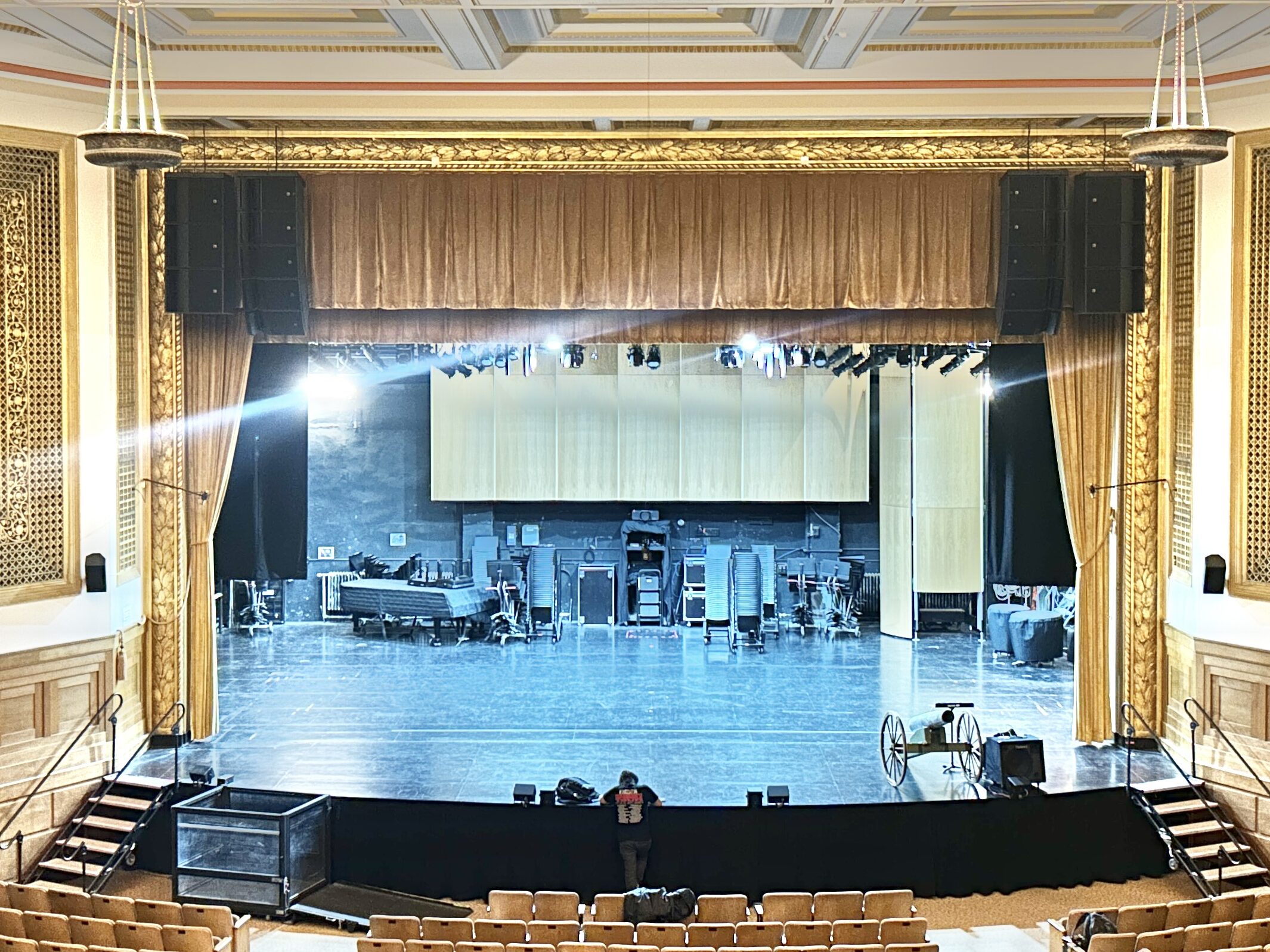
Strong Auditorium is the main performance space at the University of Rochester for music ensembles, dance groups, guest speakers, and similar events. Recently, the sound system was upgraded be much more powerful. The increased power of the new system highlighted some acoustic problems with the room, notably a slap-back echo heard on stage and pockets of intense bass resonance. The goal of our project is to identify specifically what is causing these issues, accurately simulate the room, and then find and propose solutions.
Problem Identification
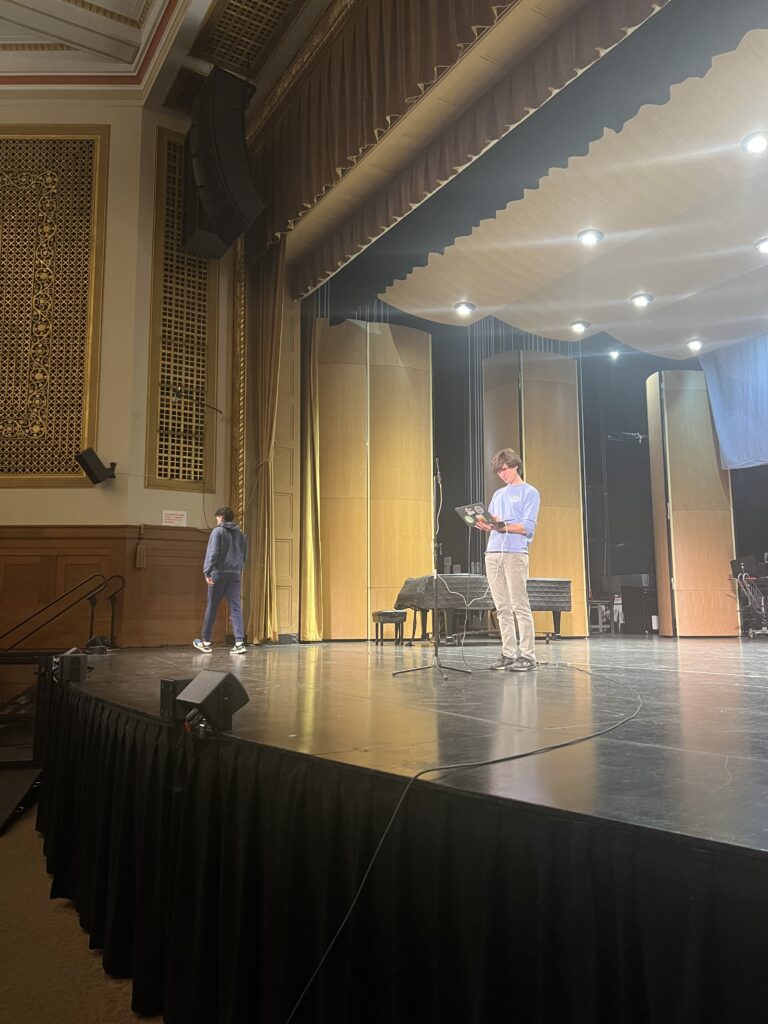
In order to define the room’s problems more specifically, we took room impulse responses. Impulse responses (IRs) are measurements of a room that show how it reacts to input stimuli. You can analyze IRs in many ways to show things like reverb time, clarity, or frequency response. We analyzed the low frequency around the room to create a heat map of bass resonance. The strongest resonant locations were on stage, in the balcony, and especially, in the center of the room. There were also noticeable places lacking power. In addition, we found the time delay for the slap-back echo audible on stage, around 110ms.
Simulation
To simulate the room, we used the acoustic simulation software Treble. Treble takes a 3D model of a space and simulates the acoustics using wave tracing and room geometry calculations upon assigning materials to each surface. We used Treble to confirm the issues we measured and then simulate various solutions.
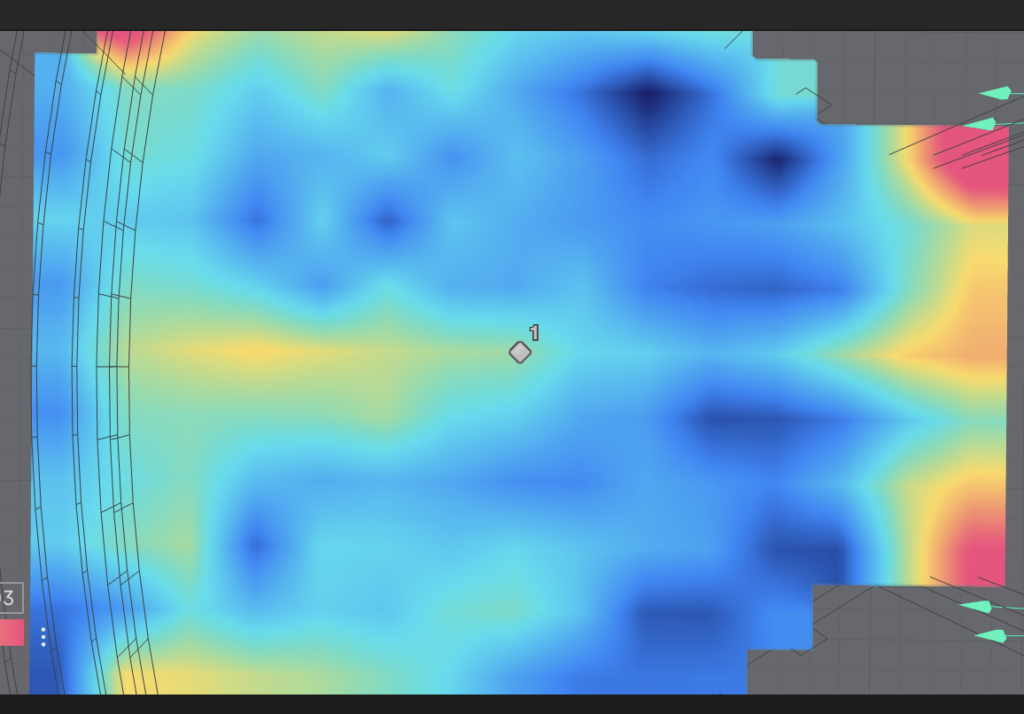
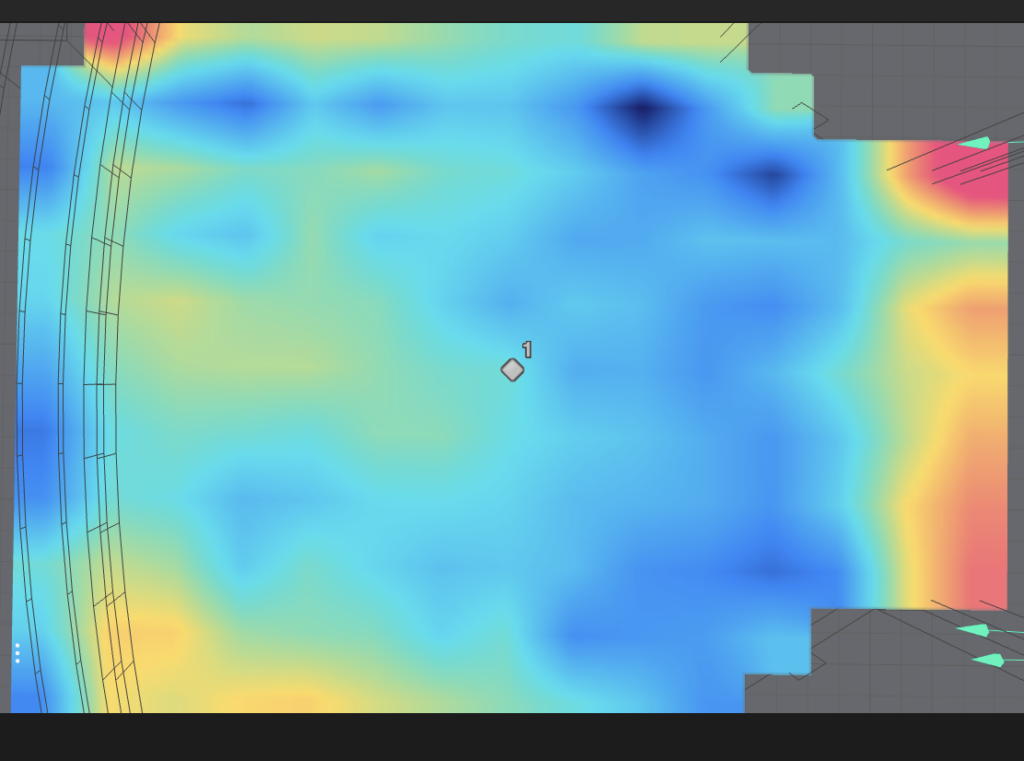
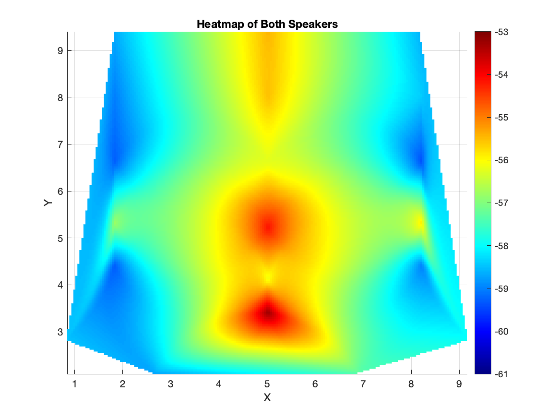
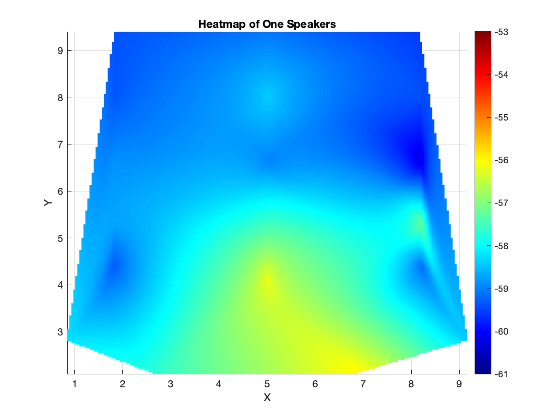
The bass resonance issue is partially an issue with the room geometry and partially an issue with the current sound system. The two sets of subwoofers on either side of the stage create pockets of resonance and ‘dead zones’. These are due to constructive and destructive phasing. The graphs below are heat maps of low-frequency power in the simulated strong auditorium, where warmer colors mean stronger resonances. The left graph represents the current setup with both subwoofers active. There is a channel of power in the center of the room and built up onstage. This agrees with our measurements of the auditorium. The right graph is with only one subwoofer active; this shows a marked improvement in evenness of the distribution.
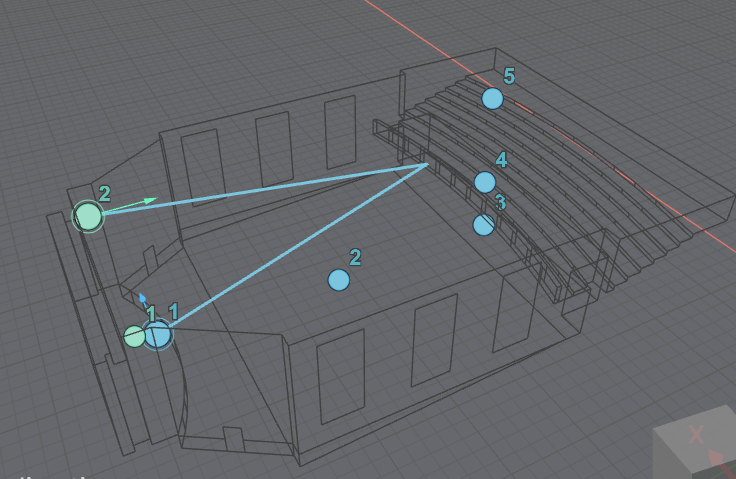
For the slap-back echo, we had to tweak speaker placement in the simulation until we were measuring the right timing for the slap-back delay. Once we had achieved the correct 110 ms delay, it was clear that the echo was caused by sound reflecting off the front of the balcony and returning to the stage. Furthermore, the concave shape of the balcony focused sound onto the stage, like a lens.
Slap-back Solution: Acoustic Panel
To address the slap-back issue, we simulated the space with a row of panels across the front of the balcony. These panels were in the shape of half-barrels and made out of Owens Corning 703 acoustic fiberglass to introduce absorptive and diffusive properties to the balcony. The simulation proved successful, as it decreased the amplitude of the slapback delay by a minimum of 6dB.
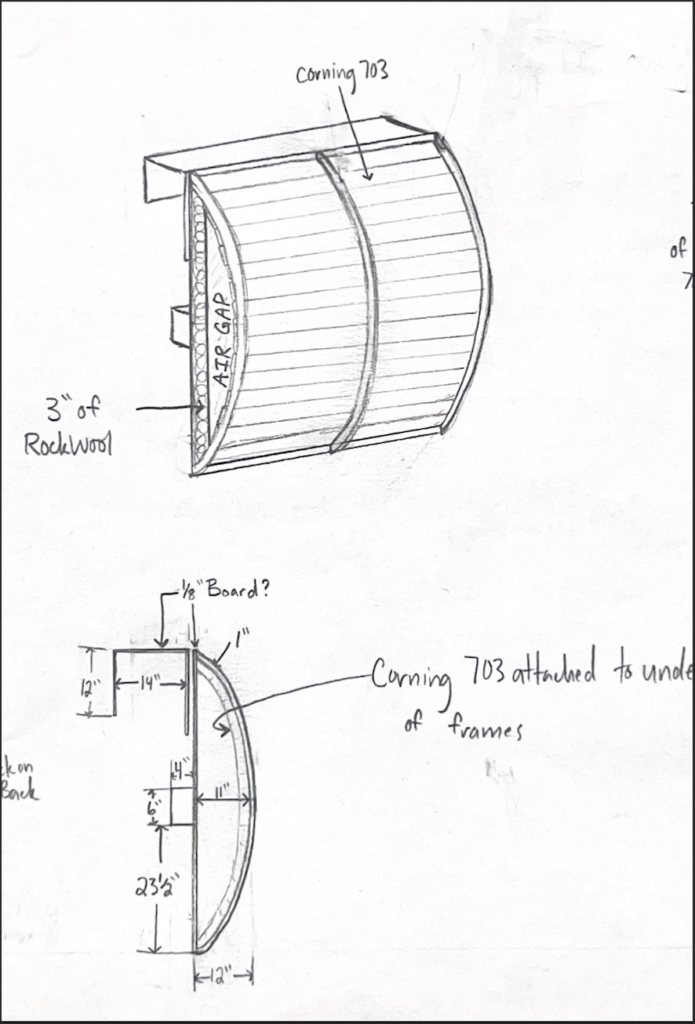
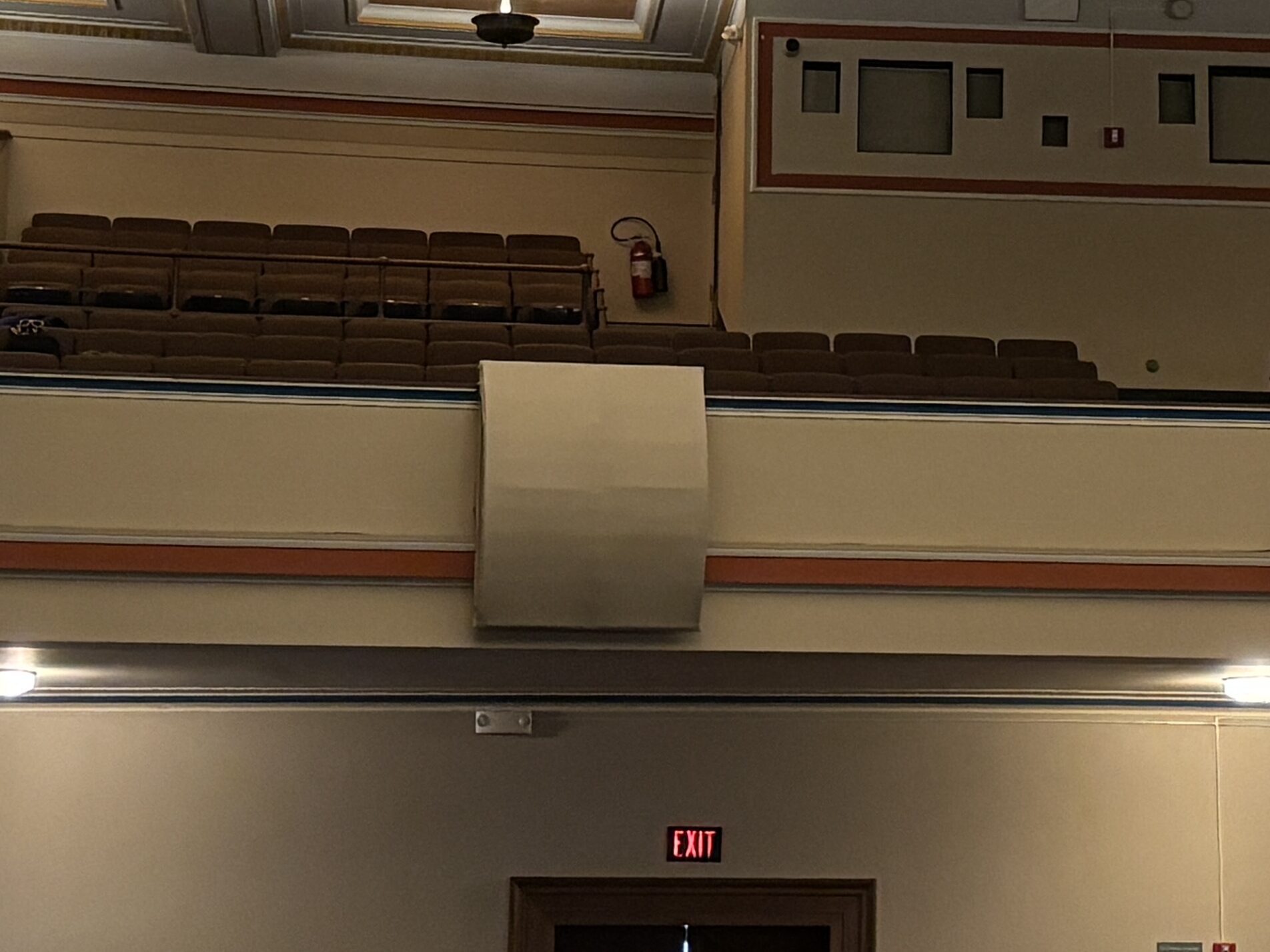
The next step was to design and construct a prototype that could be temporarily attached to the front of the balcony. A bracket mounting system was used to hang the panel over the balcony wall, allowing it to be placed and removed easily without damage. Once the design is confirmed, there will be approximately 16 panels across the balcony.
Bass Solution: Subwoofer Muting
Sometimes the best solutions are the simplest solutions! But while our final solution was easy to implement, our group still took the time to explore other options.
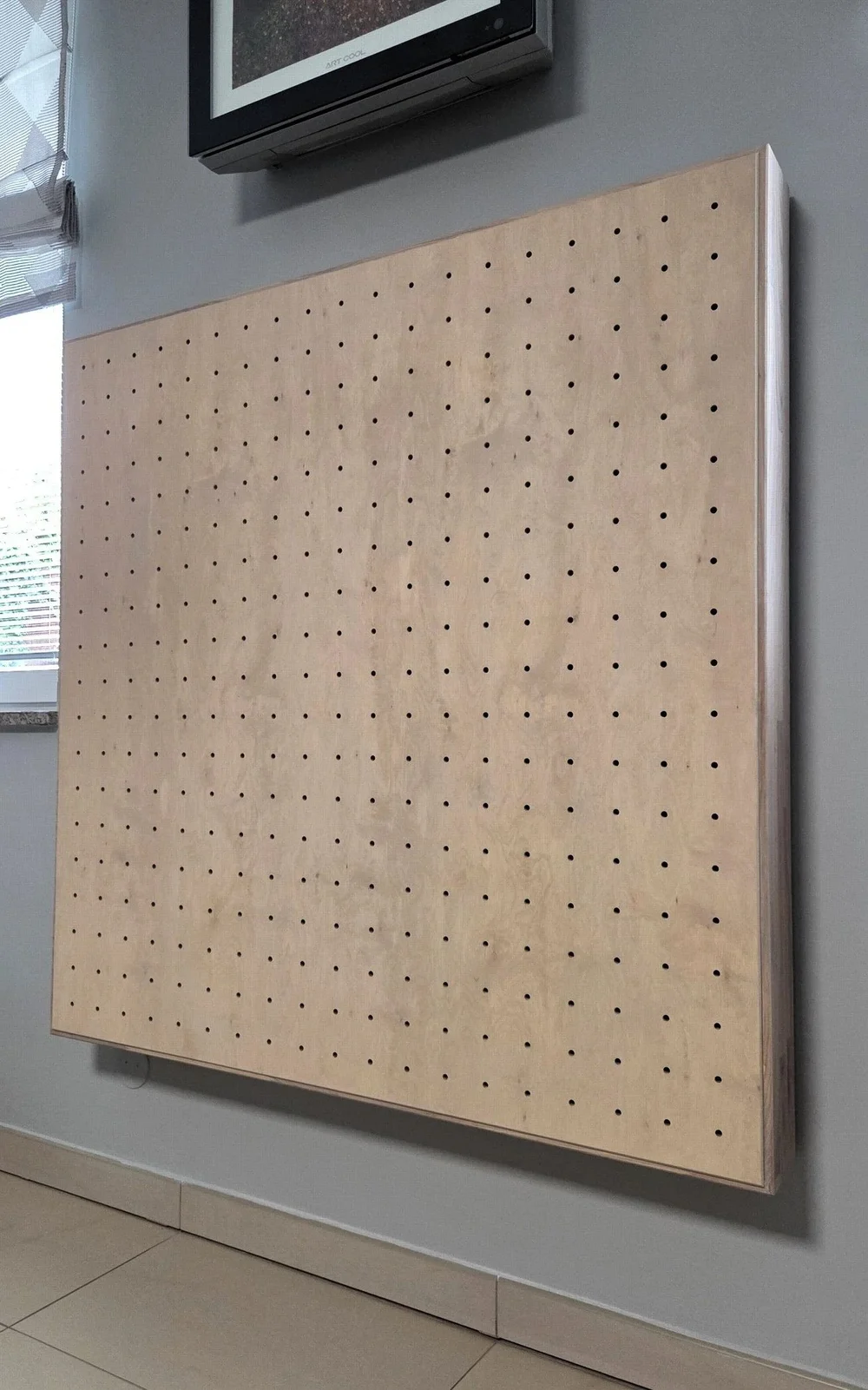
One of our proposed solutions was to use Helmholtz resonators in certain areas of the auditorium to minimize low-frequency resonance. Helmholtz resonators are containers with a hole and a neck that can resonate at tuned frequencies based on their dimensions. Blowing air over the top of a beer bottle is an example of this phenomenon. For our purposes, the Helmholtz resonators would be built to absorb the specific frequency. However, our simulations showed that even if the back wall was covered in Helmholtz resonators, there would still be little change to the room and only diminish bass frequencies by a maximum of 3dB. Furthermore, trying to use that many Helmholtz resonators would be incredibly expensive, time-consuming to build, and inappropriate for the aesthetics and functionality of the auditorium.
Based on the results of our simulation, muting one subwoofer yielded the best outcome. We came back into Strong Auditorium, measured the impulse responses around the room with the subwoofer off, and compared them to our previously measured data. The graphs below represent the auditorium viewed from above, where the stage is at the top, and the balcony is at the bottom. Red is high energy, and blue is low energy, all below 60Hz. It’s abundantly clear that bass resonance is far more evenly distributed around the room, instead of building up in the center.
Next Steps
With these best solutions for the space determined, the last challenge of our project is to propose a full scale implementation of these solutions. After constructing the prototype and fitting it in the room, we identified a few improvements to the design for the final version. The main difference will be replacing the temporary brackets with a permanent mounting system, which will change the construction of the back of the panel. With the improved design, we need a contractor to construct 16 of these panels so that they can be installed along the entire width of the balcony. Once those are constructed, we would need to work with the school to facilitate the installation of the panels.
With respect to the bass resonance problem in the room, the best solution is to find a better place for the subwoofers such that there is a more even distribution of bass throughout the room. Temporarily we suggest muting one half of the array so the low frequencies are more evenly and predictably spread throughout the room.