
Motivation
Microscope objectives are often complex with many expensive elements, many of these used in color correction. With the recent research coming out of Professor Greg Schmidt’s lab on the use of gradient index (GRIN) materials to correct chromatic aberrations, our goal was to see if a GRIN element with less than 10 waves of power could replace low power color correcting doublets and triplets in high NA microscope objectives while maintaining the same performance at the diffraction limit. The aim was to take an existing, visible spectrum, infinitely corrected, microscope objective patent of NA > 0.9 with a field of view of 100 μm, an EFL of 2mm, and reduce the element count by at least three while keeping manufacturability consistent with known GRIN material research. This would be a proof of concept for the design and manufacture of simpler, less expensive microscope objectives using GRIN.
Patent Selection
Prior to ultimately switching to GRIN plates as a replacement, we attempted to optimize several patented designs, aiming first to comprehensively fine-tune various optical characteristics; this was because GRIN structures are suitable only for low-power applications.
Example patent
The patent we ultimately selected is US05132845[5]; its initial system already possesses sufficient magnification capability to satisfy the requirement for an extremely short overall length, following certain optimizations.
The following is our optimized optical system, which meets all specifications:
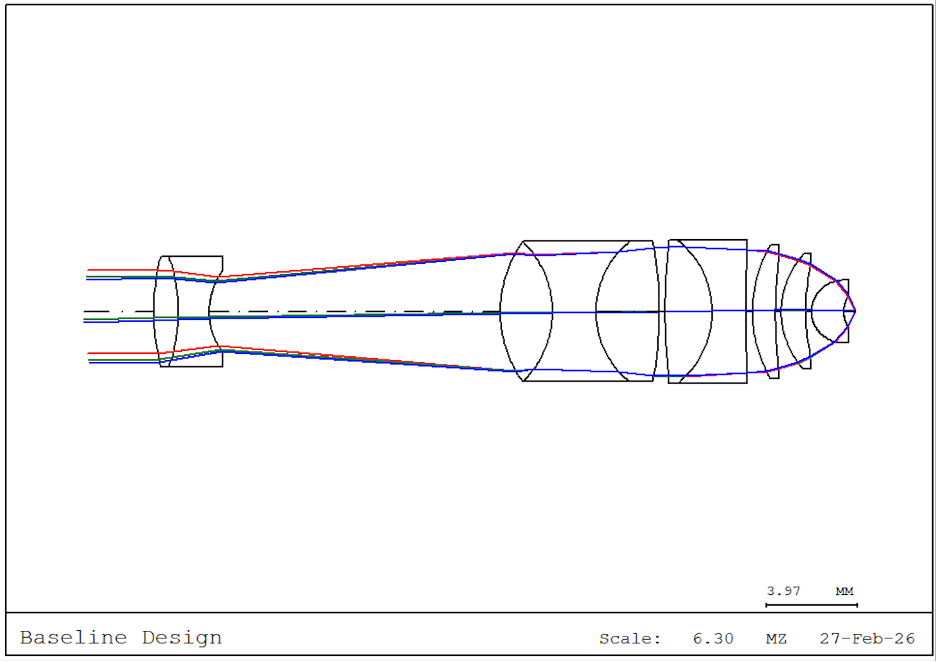
Figure 1. Baseline Design
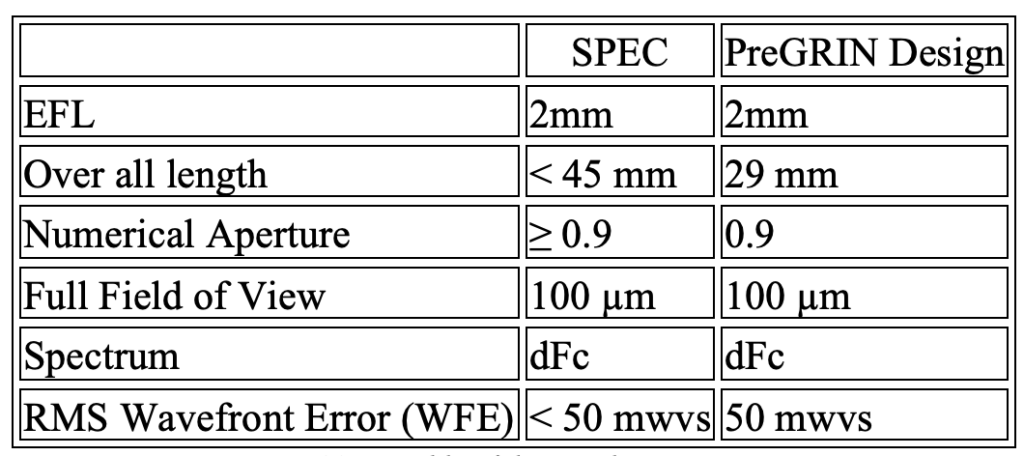
Figure 2. Table of the Baseline Design
To simulate a GRIN (Gradient Index) medium in CODE V using Zernike polynomials combined with the Tianyi model (referring to the specific axial-radial coupling method or a custom expansion), our team implement two User-Defined Gradient (UDG).[1][2][3] The lens view and performances are shown below:
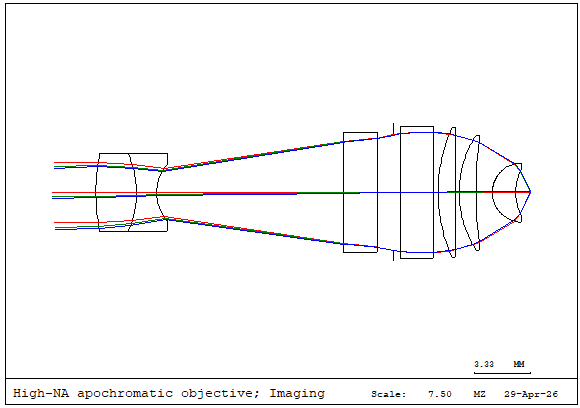
Figure 3. Design after replacing two cemented lenses with GRIN lenses.
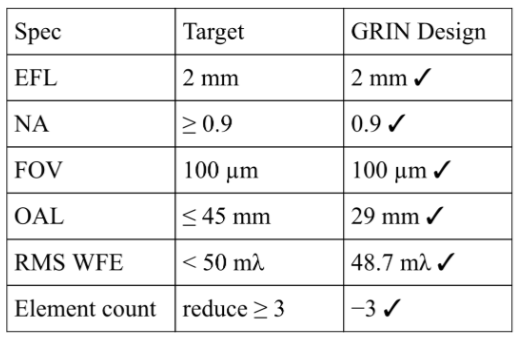
Figure 4. Table of the GRIN replaced Design
Shown below are two plots illustrating the refractive index versus xy coordinates for GRIN lenses. Although they meet the specified standards, it is worth noting that the second lens exhibits a relatively large dn value, which may render it unmanufacturable. This is likely due to the second lens bearing an excessive optical power load.[4]
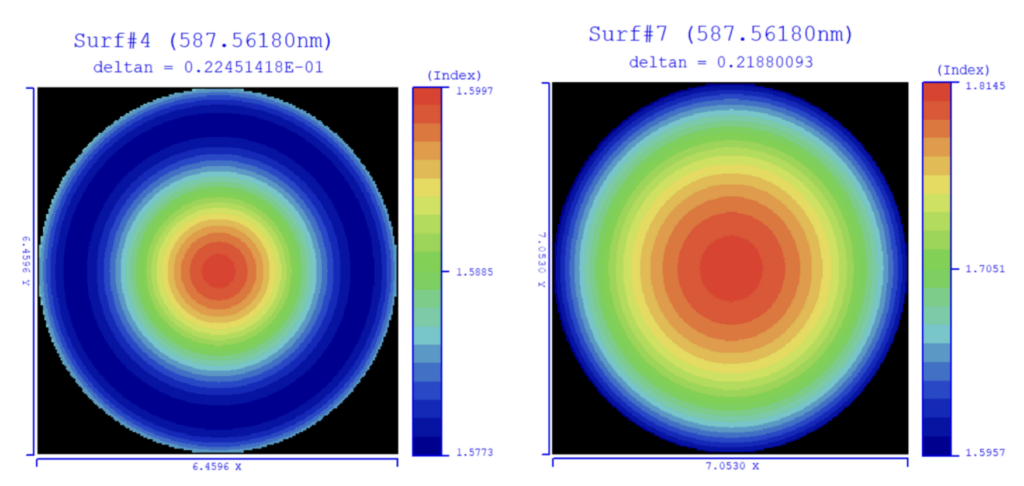
Figure 5. The image on the left shows a ternary GRIN replacing the first cemented triplet, while the image on the right shows a second ternary GRIN replacing the second cemented doublet.
Future Work
Subsequently, we will conduct a tolerance analysis to ensure that temperature variations are duly taken into account. The final step involves a confirmation with the customer; based on the requirements outlined in the specifications, we will either modify the system to enhance manufacturability or make compromises regarding certain critical parameters.
Reference
[1] Desai, Ankur Xavier. Chromatic Properties of Freeform and Multi-Material Gradient-Index Optics. 2024.University of Rochester, PhD dissertation.
[2] Yang, T., et al. “Efficient Representation of Freeform Gradient-Index Profiles for Non-Rotationally SymmetricOptical Design.” Optics Express, vol. 28, no. 10, May 2020, pp. 14788–14806.
[3] Desai, Ankur X., et al. “Achromatization of Multi-Material Gradient-Index Singlets.” Optics Express, vol. 30, no.22, 2022, pp. 40306–40314.
[4] Wu, Yuchen, and Greg R. Schmidt. “Design and Tolerance of Polychromatic Multi-Material Freeform Gradient-Index Phase Corrector Plates.” Optics Continuum, vol. 5, no. 2, 15 Feb. 2026, pp. 466–478.
[5] Suzuki, Toshinobu. High Magnification Objective Lens System. US Patent 5,132,845, 21 July 1992.