
Author: Yikun Jin, Qiang Lin
Introduction
Thin film lithium niobate (TFLN) is a promising platform for nonlinear integrated photonics, due to its strong quadratic nonlinearity and compatibility with CMOS. This thesis proposes that dichroic directional couplers, as parts of micro resonators, to isolate second harmonic generation only in periodic poled lithium niobate (PPLN) waveguides. The directional couplers are designed and optimized using COMSOL to achieve high coupling ratios at 1560nm and low coupling ratios at 780nm.
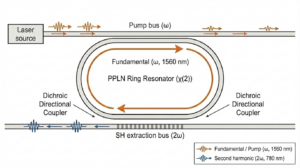
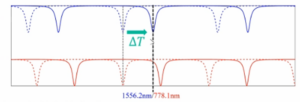
Second Harmonic Generation(SHG) is a parametric process. To avoid second harmonic light taking over the generation process in the cavity, we engineer the external coupling using dichroic directional coupler. The coupler can isolate SHG only in PPLN waveguides, no longer requires resonance alignment between fundamental and second harmonic light, and avoids photorefraction caused by cavity enhance second harmonic light.
Theory
The power coupling efficiency of the adiabatic coupler can be estimated by the Landau-Zener formula[1]: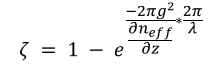
Coupler Geometry
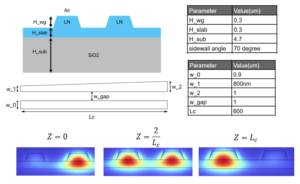
Fabrication Plan for Testing
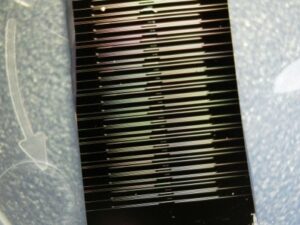
With the help of graduate student Jeremy Staffa from Qiang Lin’s group, there are 9 sets of devices fabricated. Each set includes one calibration micro resonator, one adiabatic coupler micro resonator, and one waveguide with an adiabatic coupler.

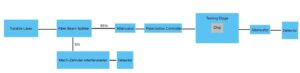
Testing Layout
Testing Result
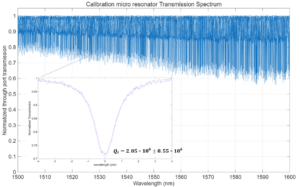

The intracavity ADC introduces additional round-trip loss compared with the calibration resonators, reducing the extracted intrinsic quality factor from 2M to around 1M. However, the ADC resonators still maintain million-level intrinsic Q, indicating that the coupler can be incorporated without severely degrading the cavity performance. The 780 nm straight ADC measurements show the splitting >15dB, confirming weak coupling of the second harmonic light.
Reference
[1] Xiang Guo, Chang-Ling Zou, and Hong X. Tang, “70 dB long-pass filter on a nanophotonic chip,” Opt. Express 24, 21167-21176 (2016)
Acknowledgement
I would like to thank Prof. Qiang Lin for providing me with this opportunity to work on integrated nonlinear photonics under his guidance. I am also grateful to Prof. Knox for his advice on my proposal. Finally, I would like to extend my gratitude to Jeremy Staffa for providing technical advice on design simulation and fabrication assistance.