
Introduction
Millions of Americans wear soft contact lenses, but there is currently no method of quantifying contact lens attachment to the eye. As a result, Bausch + Lomb has requested a testing platform to better understand the forces that are responsible for the attachment of a contact lens to the eye. Since lens attachment is directly correlated with patient comfort, understanding these forces will inform lens design and improve product output.
Our team has designed a physical device to measure the removal force between a contact lens and a model eye. Our ultimate goal with this device is to reduce the number of lens designs that require revision following a clinical trial.
Conceptual Overview
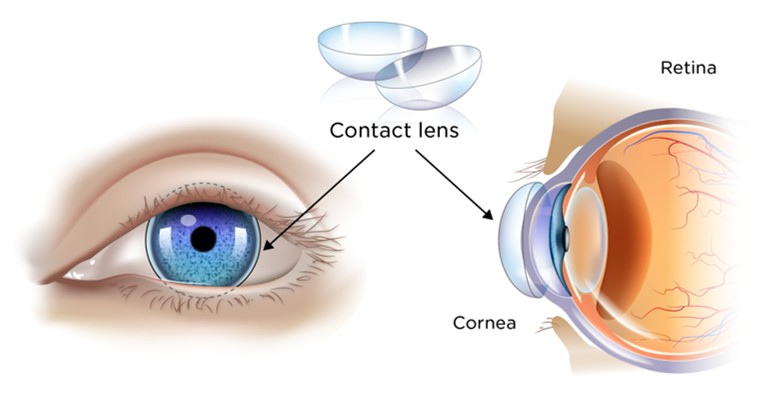
The contact lens primarily rests on the cornea, the transparent outer layer of the eyeball that protects the eye and provides its focusing power [1].
Multiple forces are responsible for keeping the contact lens attached to and centered on the cornea. Suction pressure, the net negative pressure that develops because of tear film beneath the lens, is thought to be the primary driver of lens attachment. At the molecular level, adhesive forces are also involved in modulating the interactions between the contact lens, tear film, and cornea. Lastly, the lens is elastic, so the deformability also affects how the lens interacts with the eye [2]. By investigating the overall removal force of the contact lens, we aim to provide B+L with a big-picture overview of the interplay between these forces.
Systems Level Overview
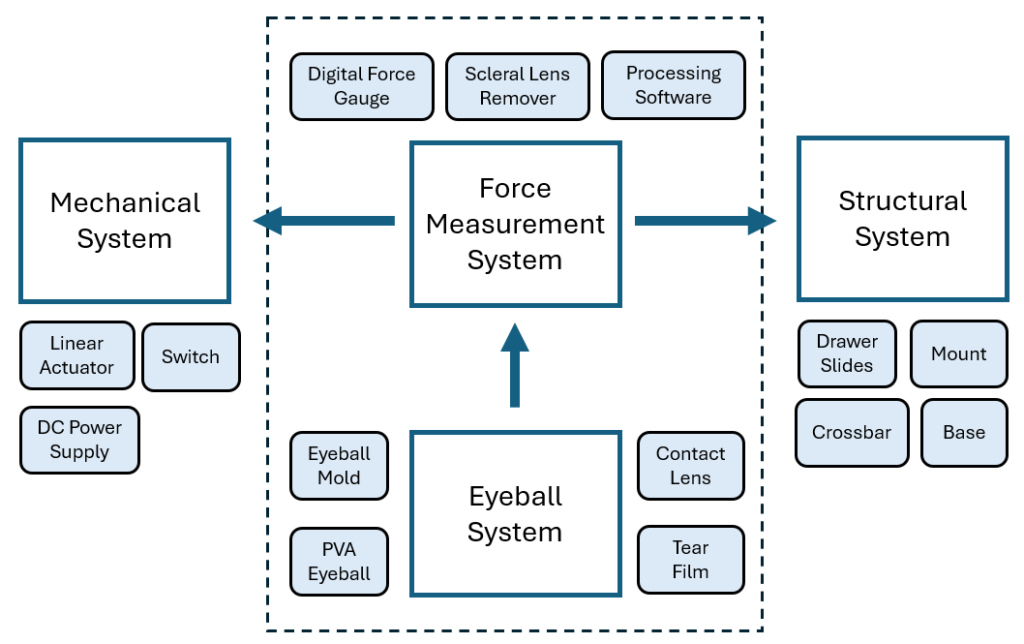
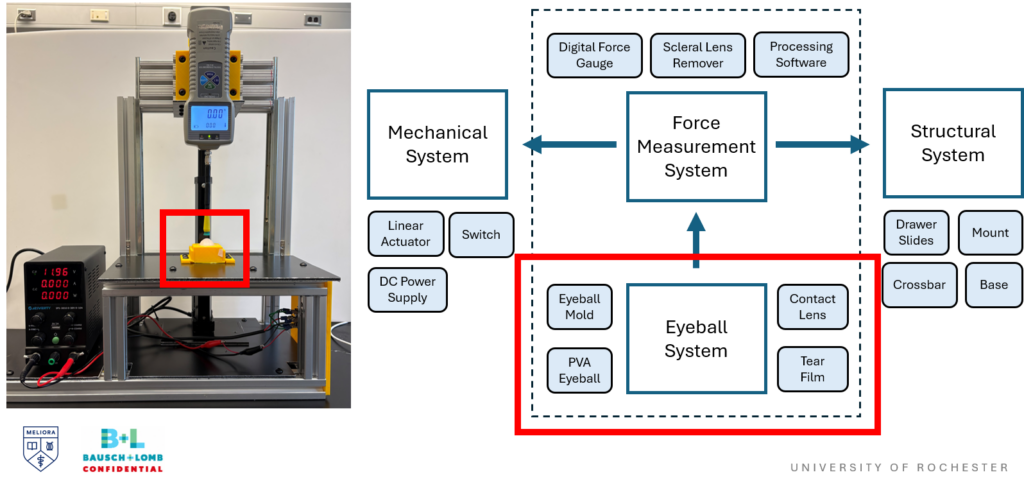
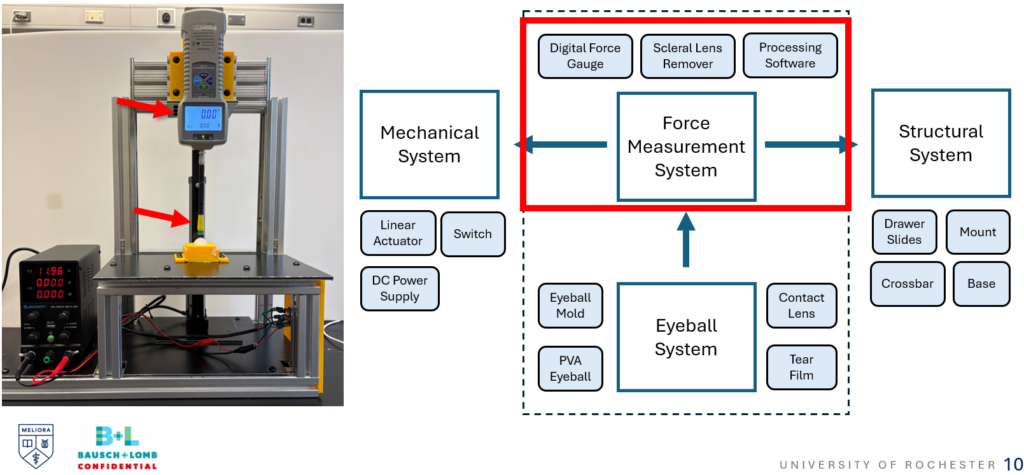


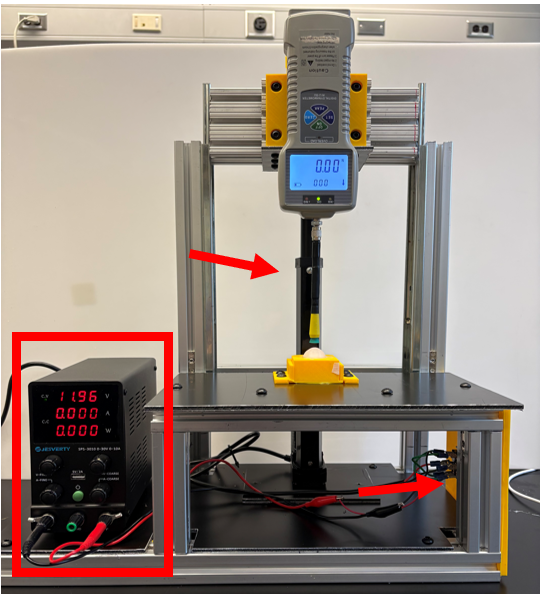
Our device can be broken down into 4 subsystems that interact with one another to keep it operational. More details on each system are available below.
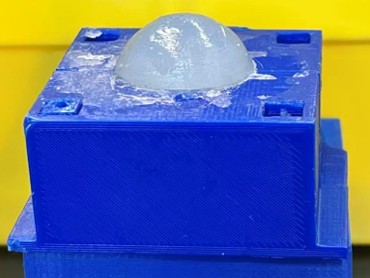
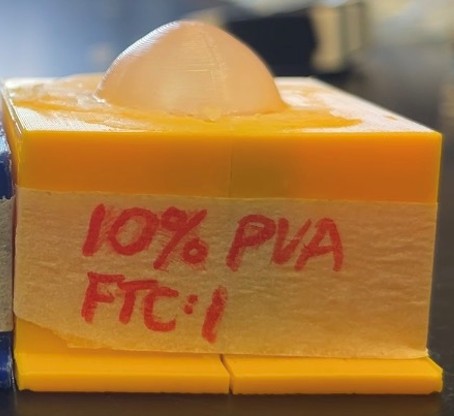
We used a model of an eyeball provided by the B+L Contact Lens Design Team to create a custom mold for fabricating our own PVA model eyeballs. Our PVA eye models have properties comparable to those of a human cornea, allowing us to better replicate the lens interaction with the eye.
The eyeball model subsystem includes the eyeball molds designed by the team, which also serve as holders to keep the eyeball in place during testing, the PVA model eyeball, the contact lens, and contact lens drops used to simulate the tear film.

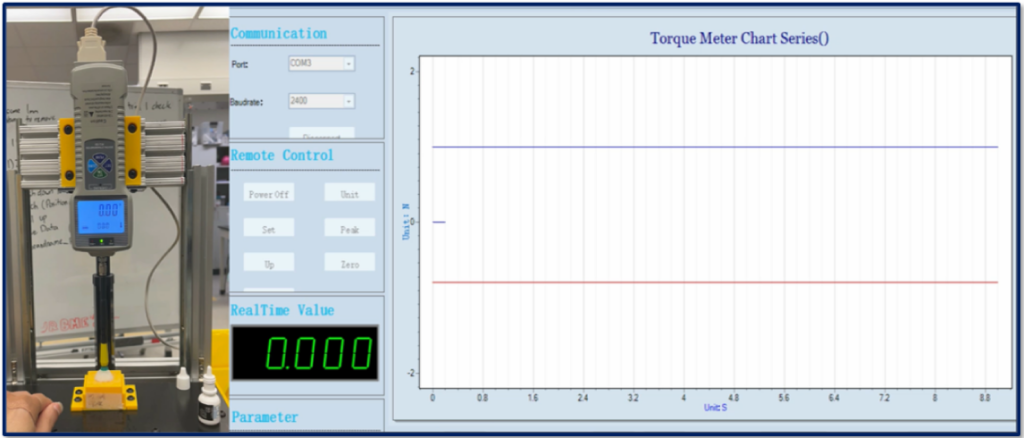
The force measurement system is responsible for recording the force to remove the contact lens. The digital force gauge has a 0.01N resolution and displays a real-time force vs. time graph.
The scleral contact lens remover is also part of this force measurement subsystem, which interfaces the digital force gauge to the contact lens on the eye model.
The structural subsystem comprises the device’s frame, made of t-slot aluminum extrusion and aluminum sheets. The frame holds the drawer slides, along which the crossbar moves.
The red arrows in the photo below point to the components of the structural subsystem.
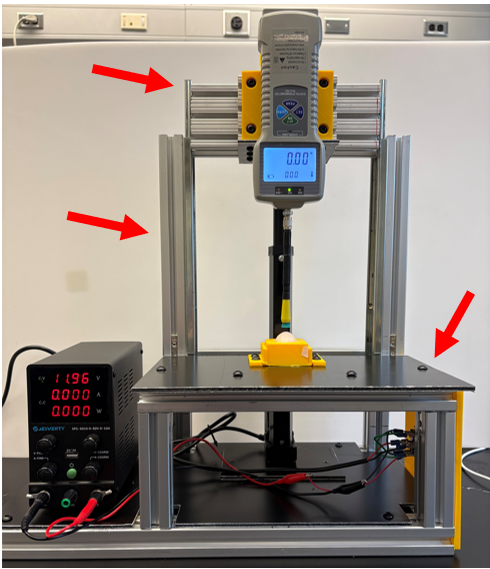
The mechanical subsystem is responsible for moving the crossbar up and down using the drawer slides that are a part of the structural subsystem. We use a DC Benchtop power supply to power the linear actuator that moves the crossbar, and a pole-reversing switch allows the user to control the direction of motion.
Evaluation of our Design
Problem: We needed to know whether the position at which the user pinches the scleral contact lens remover to generate the vacuum force significantly influences the measured peak removal force.
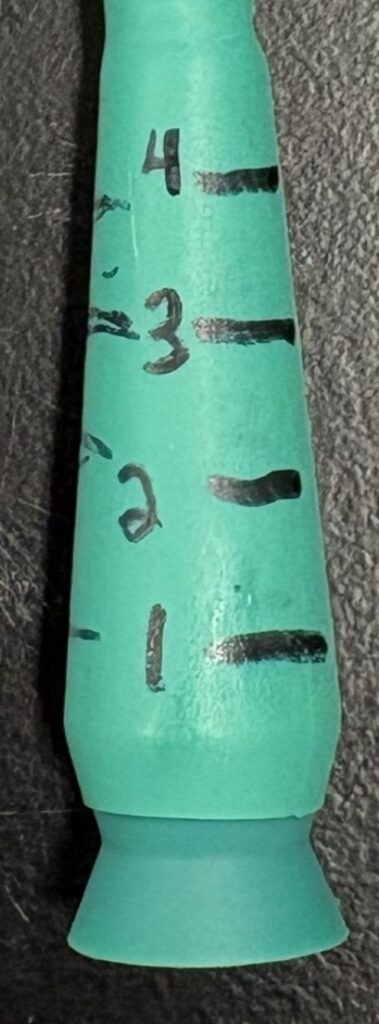
We marked on our scleral contact lens remover four positions to pinch at to test for pinch position invariance. We performed 10 trials at each pinch position and recorded the peak removal force to be used in statistical analysis. We then developed MATLAB code that identifies the correct peak for the removal force, then uses ANOVA and post-hoc statistical analysis.
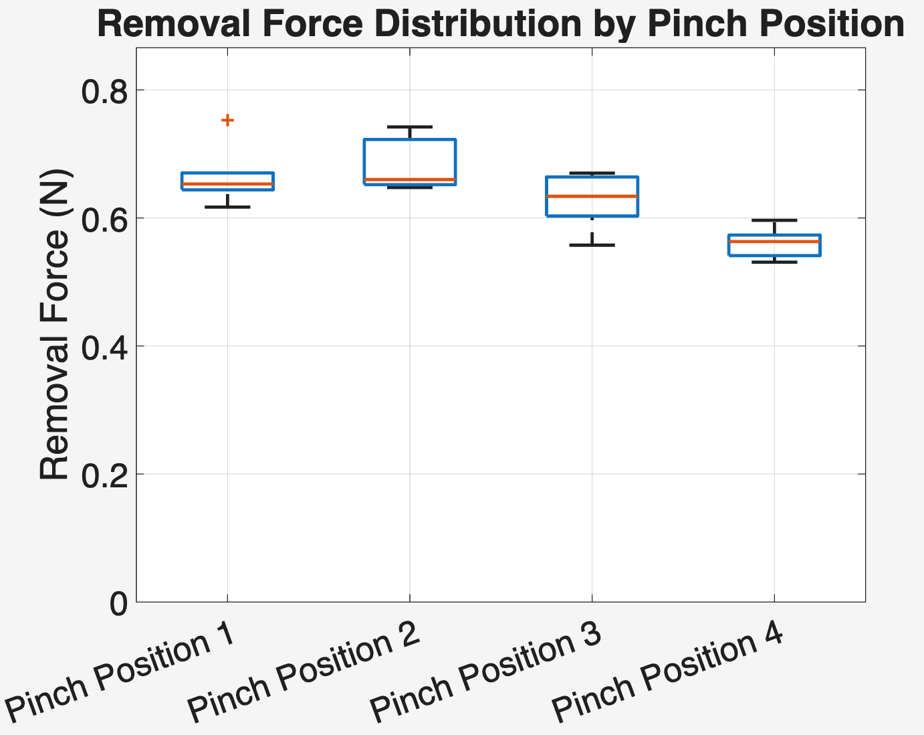
Solution: We found that positions 1, 2, and 3 were NOT significantly different. However, during testing at position 4, we found that the vacuum force was insufficient to remove the lens. Therefore, as long as the user pinches between pinches 1-3, enough vacuum force will be generated to lift the lens from the eye.
Pilot Testing of Device
We needed to evaluate whether our device could successfully detect differences between comfortable and uncomfortable contact lenses.
Problem: We could not source uncomfortable contact lenses, so we needed to manufacture our own positive control to test our device with.
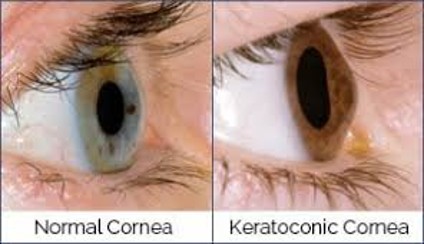
Our positive control is an eye model we custom-made to represent a patient with keratoconus, an eye condition characterized by a larger-than-normal bulge and increased sensitivity at the center of the cornea. This leaves many people with keratoconus who need contact lenses unable to wear daily soft hydrogel lenses.
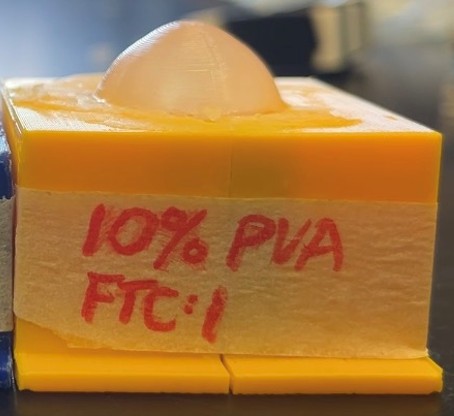
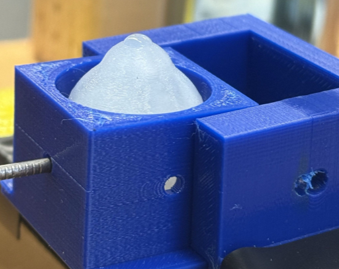
We tested our device using the keratoconic eye and the healthy eye model that was provided by the B+L Contact Lens Design Team. We performed 10 trials per eyeball model, using the same SKU contact lens for all.
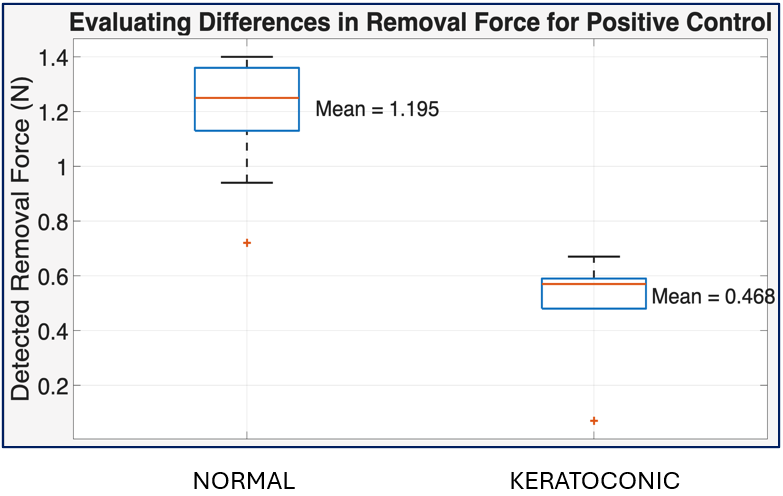
Solution: The device was able to report statistically significant differences in the peak removal force in our pilot test. This means our device can successfully distinguish between contact lenses in both comfortable and uncomfortable scenarios.
Future Directions
Computerized control of lowering the crossbar
Pinch automation
Different pinch/contact methods
Diaphragm to simulate a “blink” better, and ensure a full seal of the lens to the model eye
Testing of different eye models to look at scenarios of dye eye, loss of elasticity in the cornea with age
Testing of different eye geometries to represent different ages, ethinicities, and genders
Acknowledgements
Bausch + Lomb Lens Design Team
Julia Chotiner
Alexander Kotelsky, Ph.D.
Alyssa Owens, Ph.D.
Philippé Pare
Terra Spurgeon
University of Rochester
Edward Brown III, Ph.D.
Mark Buckley, Ph.D.
Benjamín Castañeda, Ph.D.
Michelle Eldred
Martin Gira
Alexander McMullen, Ph.D.
Scott H. Seidman, Ph.D.
Rochester Institute of Technology
Kara Maki, Ph.D.
The Team


Bottom Photo, From left to right: Benjamin Kamenetsky, Brayden Hirotsu, Miriana Kelly, Katie Lee, Yimei (Lucy) Du
May 2026