
Introduction
Traditional optics bend light using a curved surface and are homogenous materials made of a constant refractive index, limiting each lens to refract light only at each surface. Gradient Index (GRIN) optics bend light through varying the refractive index throughout the lens. By introducing a refractive index profile throughout the lens, additional degrees of freedom are introduced into the system, allowing designs with:
•Fewer lens elements
•Smaller packaging
•Reduced aberrations
•Additional Design Freedom
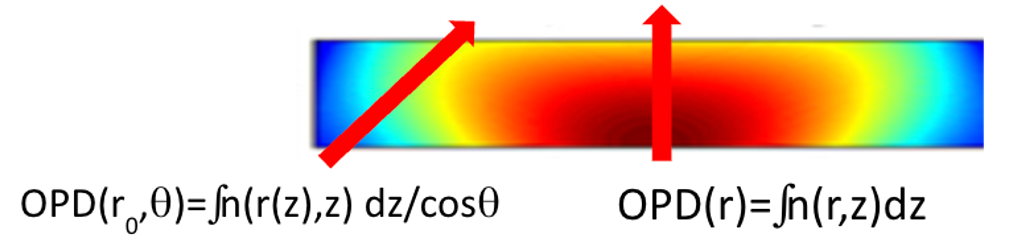
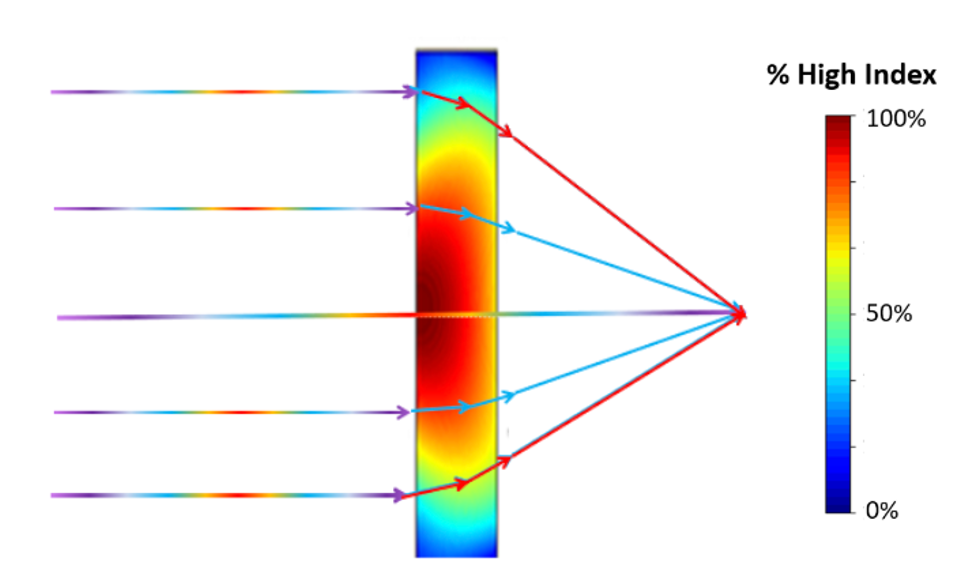
Nanovox creates GRIN optics by diffusing small drops of higher index materials into a medium with a lower refractive index. The refractive index profile of the resulting optic can be characterized by a refractive index profile. Because this manufacturing process is dependent on the diffusion of the droplets within the optic, variability and error may be present when comparing the GRIN optic manufactured versus the target optic. Therefore, the objective of this project is to develop and implement a software metrology tool that inversely reconstructs the 3D refractive index for a given GRIN optic.
Methodology
This metrology tool can be used by implementing this procedure experimentally:
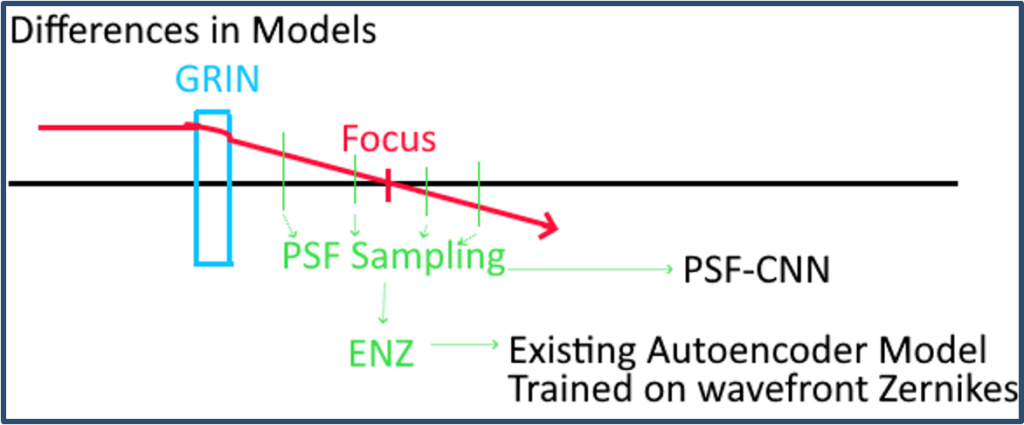
1.Send input light through a GRIN optic. The output light’s point spread function (PSF) is analyzed at several through-focus positions.
2.Extended Nyborg-Zernike (ENZ) Theory is used to collapse the PSFs into one wavefront described by Zernike polynomials.
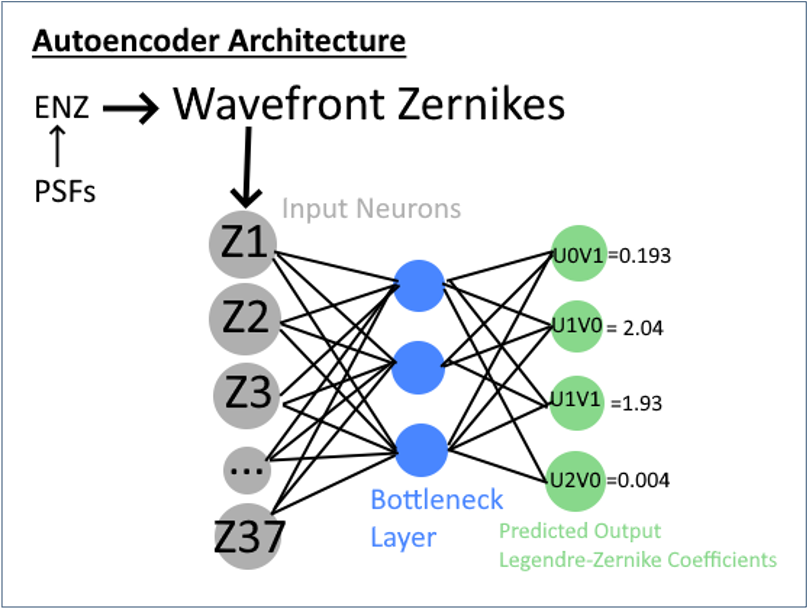
3.The metrology tool built will predict the 3D Legendre-Zernike polynomial GRIN terms, reconstructing the actual manufactured GRIN optic and allowing comparison to the target design.
This metrology tool uses a trained residual network machine learning model that was trained on millions of generated GRIN lenses. To develop this tool, the required approaches and tasks were broken into 3 phases:
1.Phase #1: Dataset Generation: Datasets from simulated GRIN optics in Zemax were created to train the machine learning models in the following phases.
2.Phase #2: Autoencoder approach coupled with ENZ Theory: Use Zernike coefficients from GRIN optics in Zemax for as inputs to the machine learning model.
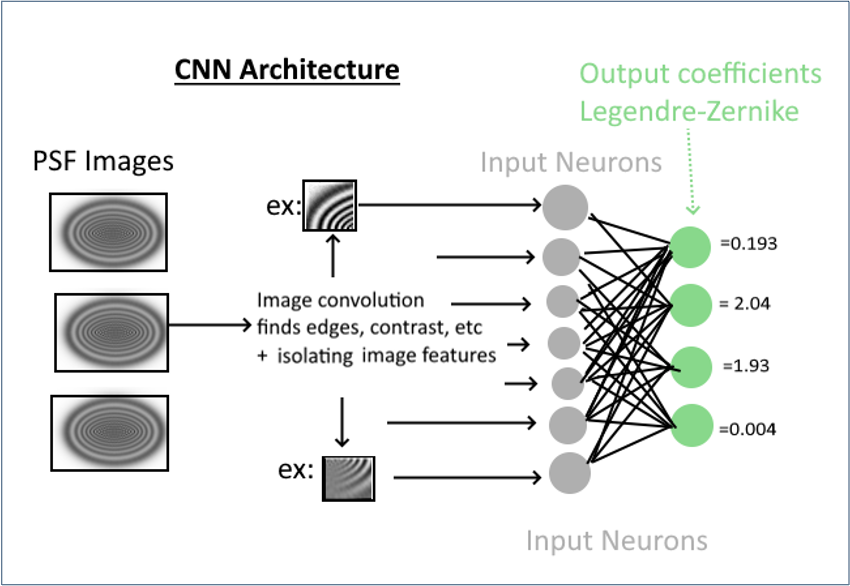
3.Phase #3: Convolutional Neural Network (CNN) approach: Input PSFs from Zemax for each GRIN into a more complex machine learning model.
Training & Testing the Autoencoder
CNN Architecture
Results
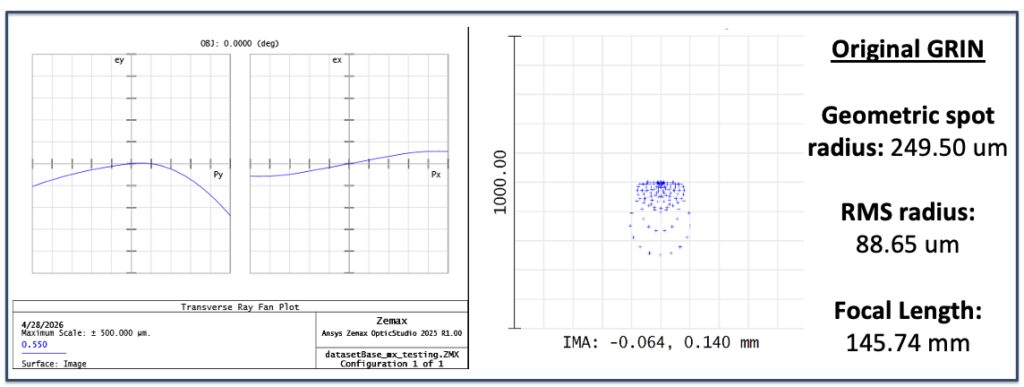
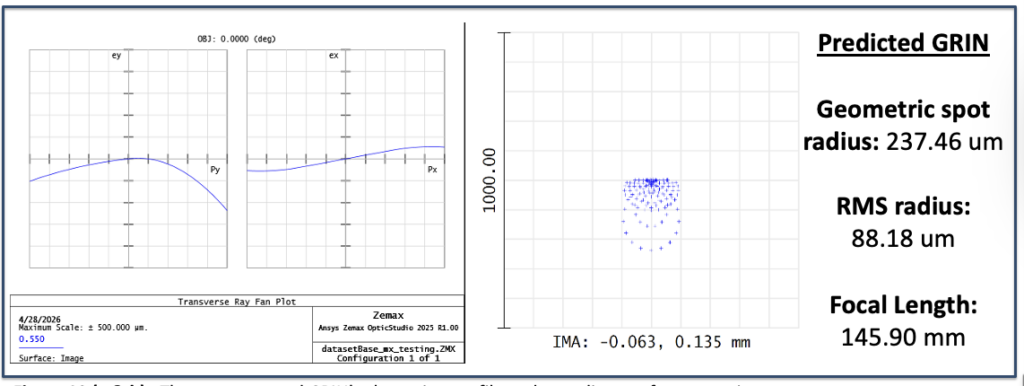
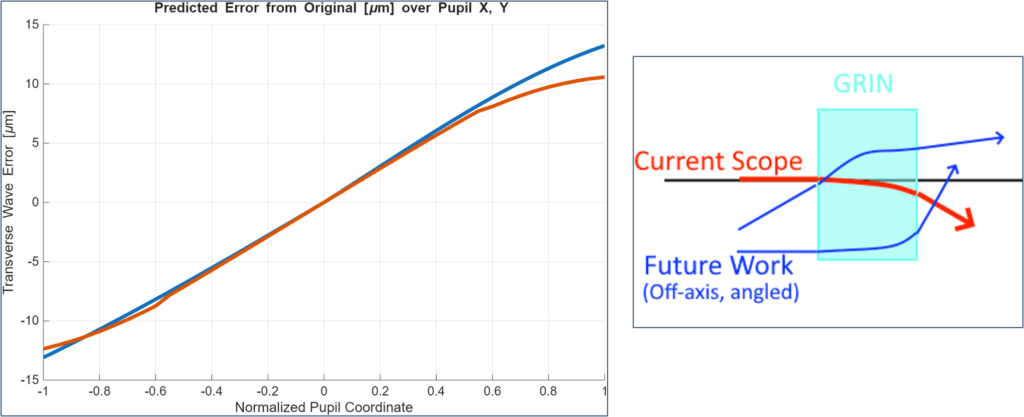
The autoencoder scheme retrieved amazing results, outputting Legendre-Zernikes that were extremely similar to the original GRIN systems despite the added noise.
Conclusions
•Using a suitably large number (~1 million) of sets of wavefront Zernikes and GRIN Legendre-Zernikes, a physical relationship can be learned. This overarching physical relationship can be used to accurately predict future GRIN lenses from output light.
•Based on smaller dataset tests, increasing the Legendre-Zernike order of the GRIN has nearly no effect on the performance of the autoencoder model. This suggests that the learned physical relationship is relevant for both extremely simple and extremely complex GRINs.
•The current scope of input light (see fig. 12) is highly limited but still allows for the prediction of a wide variety of GRIN lenses. If on-axis, radially symmetric light can reconstruct the entirety of a radially symmetric GRIN, it stands to reason that radially unsymmetric light (ex: with added height, angles) could accurately predict freeform GRINs.
•Future work could also further explore the relevancy of the PSF-CNN, as it is likely that the underlying physical relationship of ENZ theory can be learned by the model as well.