
The Rochester Museum & Science Center GRIN Wave Tank project aims to create a prototype of a water tank with an interactive wave actuator that is capable of simulating refraction and diffraction through water waves. The waves are projected onto the floor beneath the tank with a clear-bottom tank and a light source above. Lenses and other demonstration elements will be placed into the water to show diffraction, refraction and reflection in an interactive and approachable way by younger audiences. The project is conducted with the support of our customer, Calvin Uzelmeier, and our faculty advisors, Duncan Moore and Ed Herger.
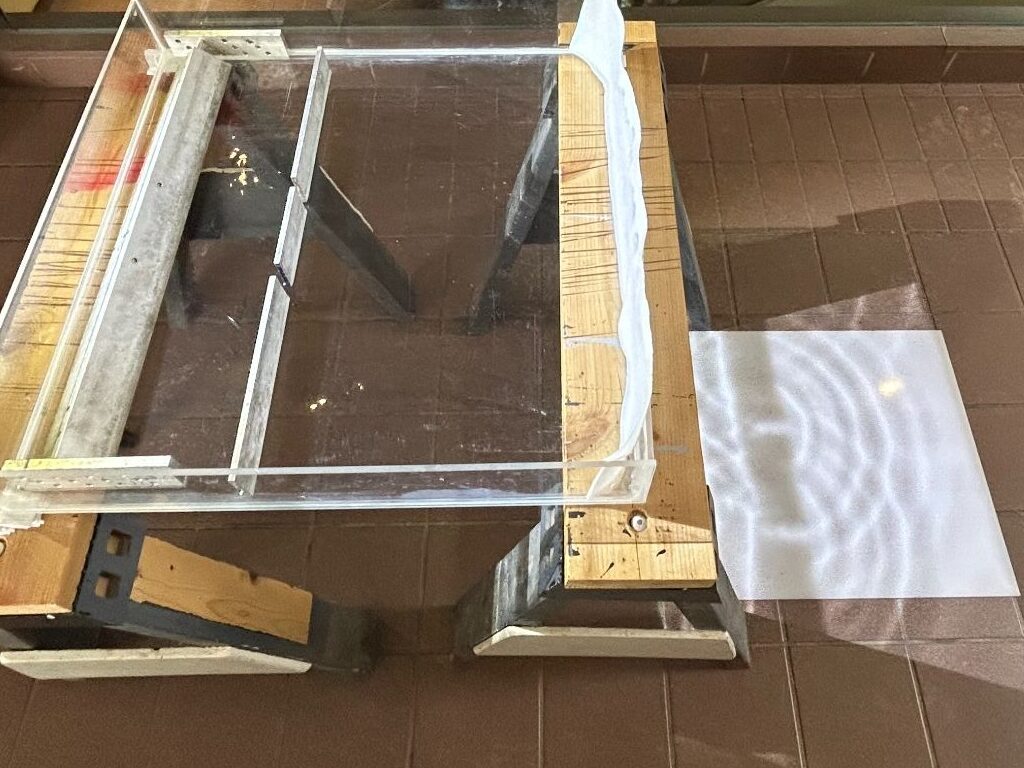
The wave tank being used to demonstrate the double slit experiment at RMSC.
The key principle behind the function of the wave tank is that the index of water, for a water wave traveling through it, varies with the depth. This allows us to simulate traditional lenses with 3D printed lenses of continuous thickness and GRIN lenses by varying the thickness of the lenses.
For normal convex and concave lenses, we used the lens maker formula assuming that our wavelength is 25mm and water depth of 3mm (water depth 8mm and lens height of 5mm).

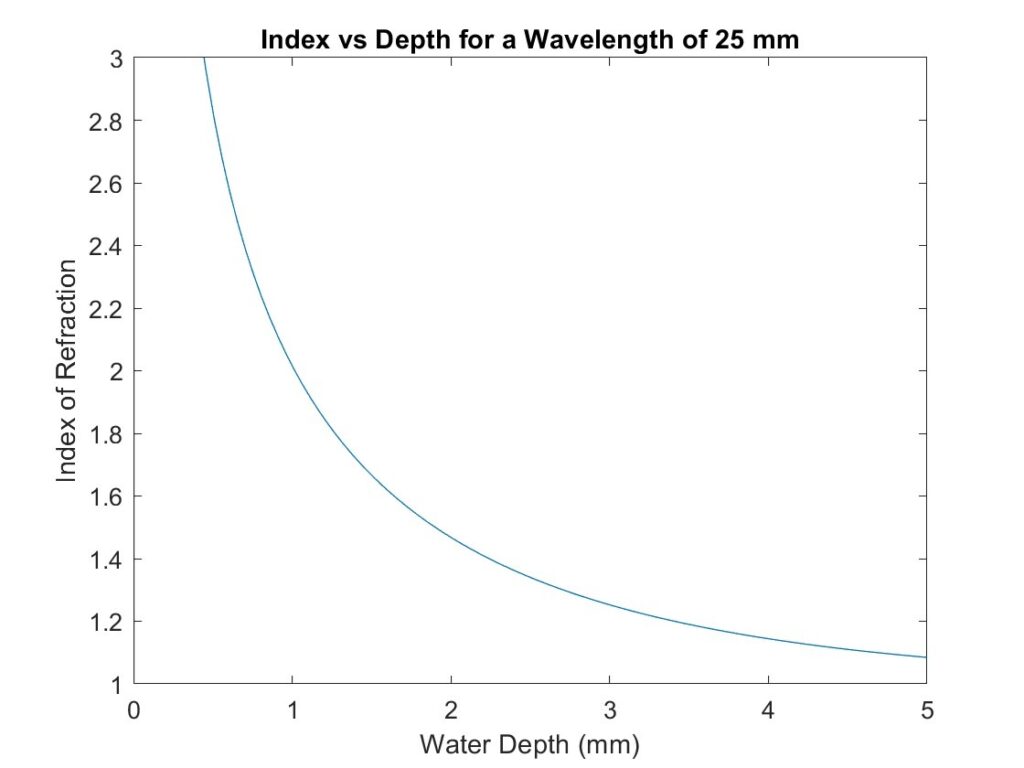
Plot of index for water wave vs water depth for a 25mm water wave.
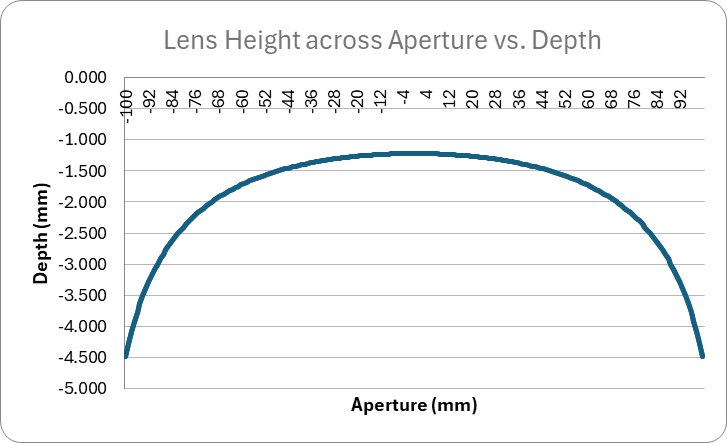
Side view profile of varying height of a GRIN Wood lens, generated with Excel sheet created by Megan Fallon.
We preformed two days of testing at RMSC, once with general audiences and once at the RIT Museum night with primarily college students. With the infographic and motorized actuator most people were able to create the phenomena on their own. Based on their interactions with the tank we created design suggestions for a full scale exhibit that RMSC will continue to develop and hopefully deploy in the near future.
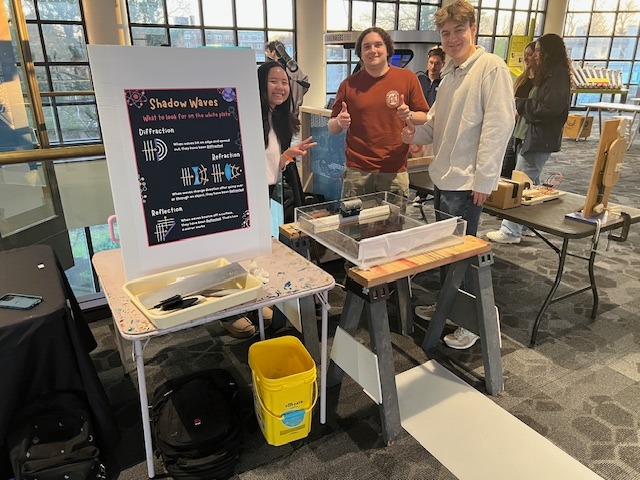
Testing tank at RMSC on RIT museum day.