The Design and Optimization of a Small Cassegrain Telescope
Team Members


Problem Statement
Satellites are highly complex and resource-intensive systems that deliver essential data and images from space, requiring significant time, cost, and technical expertise to design and maintain. Developing a small-scale version of these systems provides a more accessible and cost-effective platform for methods to study performance and testing improvements.
Specifications and Requirements
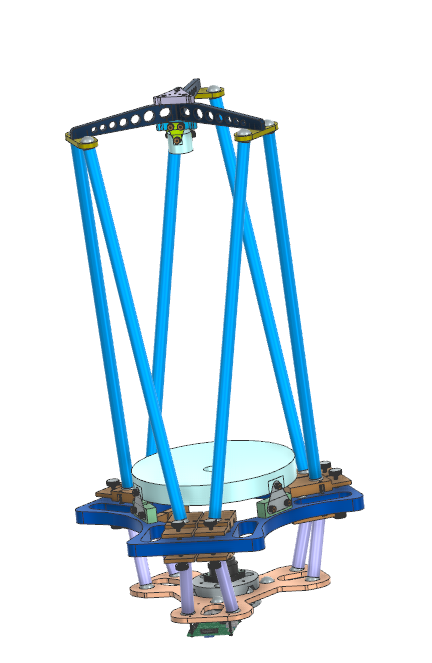
The primary requirement for this optical device is that it is cost-effective and capable of imaging. In addition, the design must imitate a Cassegrain design method.
| Value & Units | Description & Method of Evaluation |
| 18.00 G | The optical structural assembly (OSA) shall maintain positive Margin of Safety (MoS) > 0.0 under Quasi-Static Limit Loads of Lateral. Method of evaluation: Perform simulation and a tensile test using the MTS machine. Apply strain gauges to check for permanent deformation. Inspect for cracks or visible failure. |
| 180.00 Hz | The fixed-base fundamental natural frequencies of the stowed optical assembly. Method of evaluation: Simulation and perform an impact hammer test using accelerometers and a DAQ system to identify resonance peaks. |
| 10.00 % | Reduction of part count to simplify assembly. Method of evaluation: Compare the part count with the previous year’s design iteration. |
| 10.00 % | Achieve a 10% reduction in total structural weight (including lenses) from the initial CAD design while maintaining a factor of safety of 1.25 against yield. Method of evaluation: Compare the final assembly weight on a digital scale with initial NX mass-property estimates. |
| 0.00039 in | Resolution of secondary mirror adjustment. Method of evaluation: Set up the optics and image a sample target located 72 inches away. |
| 0.0039 in | The optical assembly shall maintain focus over an operational soak temperature of 122°F ±3.6°F for 60 minutes. Thermal expansion (CTE) induced defocus shall not exceed. Method of evaluation: Simulate the assembly and place it in an oven; use markers to detect any lens displacement. |
| 12 G | The optical structural assembly (OSA) shall maintain a positive Margin of Safety (MoS) > 0.0 under Quasi-Static Limit Loads of 12G (Axial). Method of evaluation: Perform simulations and verify simulations through tests. |
| 1.5 FS | Factor of safety against ultimate. |
| 1.25 FS | Factor of safety against yield. |
| 14 % | Reduction of obstruction of the primary lens. |
Design/Manufacturing